


Audiera’s BEAT token has ripped higher into early June, reviving the question traders love to ask in rotation seasons: can niche narratives break away from a soft tape in majors?
The move is not happening in a vacuum. Bitcoin and Ethereum have absorbed persistent ETF outflows, while selected AI and creator-adjacent names have printed idiosyncratic gains. That divergence is fueling a debate about whether business-model tokens tied to creator platforms can sustain relative strength.
This piece maps the market structure behind BEAT’s surge, what would be required for a true decoupling from majors, and the red flags that can quickly unwind crowded trades.
| Point | Details |
|---|---|
| BEAT’s momentum | Rallied 261% week-over-week to $4.24 on June 8, pushing market cap above $1.21B and 24h volume beyond $84M (KuCoin (news)). |
| Key technical levels | Approaching prior ATH near ~$4.91; traders flagged 1.0 Fibonacci resistance around ~$4.14 and a $5 psychological target (Followin / BeInCrypto). |
| Macro pressure on majors | Global crypto ETPs saw ~$1.67B weekly outflows, with ~$1.44B from Bitcoin products, signaling institutional selling in benchmarks (The Block reporting CoinShares). |
| Narrative rotation evidence | NEAR, cited in the AI/creator rotation, spiked ~30% on May 22 and >50% over a month even as majors faced ETF outflows (The Block). |
| Decoupling test | Creator-economy tokens must convert user growth into sustainable on-chain cash flows, avoid heavy unlocks, and maintain liquid order books to preserve strength. |
| Risk controls | Track funding, spot-perp basis, depth, emissions, and regulatory/IP risks; use tight sizing and hedge majors exposure where appropriate. |
Where BEAT Is Positioned On The Chart
BEAT’s first task is the same as any new leader: defend gains near prior supply. On June 8, the token tagged $4.24 after a 261% weekly surge, lifting its market cap beyond $1.21 billion with 24-hour turnover north of $84 million (KuCoin (news)). That pace forces both momentum funds and skeptics to watch the next few candles closely.
Technicians have highlighted the 1.0 Fibonacci level around $4.14 as a near-term battleground and the area near the previous all-time high around $4.91 as the point where early holders could take profits. A clean break and hold above $4.91 would shift the discussion from “rally back to range” to “price discovery,” with $5 acting as a psychological round number on most desks (Followin / BeInCrypto).
Volume and breadth matter as much as levels. Sustained bid depth, rising spot share versus perps, and healthy funding (neither too negative nor overheated) would argue that real demand — not just leverage — is carrying the move.
Pro tip: Track cumulative volume delta (CVD) and order book imbalances around prior highs. If breakouts come on declining CVD or thinning depth, the move is more likely to fade.
Why Majors Look Heavy While Niche Tokens Run
One explanation for the split tape is structural: institutions have been taking down exposure in benchmark ETPs. In the week reported June 1, CoinShares tallied roughly $1.67 billion of net outflows from global crypto ETPs, with about $1.44 billion from Bitcoin vehicles (The Block reporting CoinShares). When passive and quasi-passive flows exit majors, beta feels heavy even if alt narratives are lively.
At the same time, speculative capital continues to hunt for new leaders with catalysts. NEAR’s ~30% jump on May 22 — part of a >50% monthly run tied to AI and scaling storylines — is a case study in how rotation can work even against a choppy macro backdrop (The Block).
Creator-economy tokens can sit at the intersection of consumer attention, media IP, and programmatic payouts — ingredients for idiosyncratic catalysts. The catch: when majors are under distribution, correlation can snap back quickly if liquidity thins or if leaders fail key breakouts.
How Creator-Economy Tokens Actually Create Value
Not all “creator” tokens work the same way. Understanding the cash-flow paths helps separate sustainable bids from transient hype.
Core models
- Revenue-share or fee rebates: Tokens grant holders a percentage of platform fees or discounts for usage.
- Access and staking gates: Staking to unlock premium tools, discovery boosts, or gated content.
- IP fractionalization: On-chain splits for songs, videos, or artwork with programmable royalty distribution.
- Launchpads and funding rails: Token-curated markets for emerging creators, where curation and risk are staked.
- Ad/recommendation credits: Tokens as credits for promotion or algorithmic placement.
KPIs worth tracking
- Active creators and monthly publishing cohorts.
- Gross merchandise value (GMV) and take rate consistency.
- Conversion of off-chain users to on-chain payers (wallets created, first on-chain action).
- Dollar revenue per daily active user (ARPDAU) and retention.
- Emission schedule versus organic fee capture (are rewards covering real demand, or masking it?).
- Net new listings and cross-market distribution (CEX/DEX balance).
For BEAT specifically, traders will be looking for signs that platform throughput and creator adoption are scaling alongside price. Without proof of usage, momentum can detach from fundamentals and reverse when incentives cool.
A Framework: Can BEAT And Peers Truly Decouple?
“Decoupling” is more than a big green candle while Bitcoin chops. It means a lower and more stable correlation to majors across multiple regimes. Here’s a pragmatic test:
- Beta check: Does the token maintain relative strength during majors’ down days and in relief rallies, or does it only outperform when the whole market is risk-on?
- Flow durability: Are spot flows diversified across venues and geographies, or concentrated in one exchange/time zone?
- Supply overhang: Are there large unlocks, market maker loans, or treasury distributions scheduled near resistance?
- Real-world throughput: Are fees, GMV, or on-chain royalties rising independent of market levels?
- Leverage mix: Is perp OI rising faster than spot volume, indicating a fragile setup?
We already have examples of partial decoupling. NEAR’s mid-May surge despite outflows in majors shows how a focused narrative and product roadmap can draw capital even when indices look tired (The Block). For creator-economy tokens, decoupling could hinge on streaming rights wins, partnerships with distribution platforms, or on-chain royalty milestones that produce visible cash flows.
Opinion: A sustainable decoupling is more likely when a token sits on a genuine usage flywheel (creators onboard → content drives fees → fees accrue to token utility) rather than on emissions-led farming.
On-Chain And Order Book Signals Worth Your Time
Even if you don’t chase, building a watchlist and a set of triggers helps you react faster when momentum matures — or breaks.
Liquidity and leverage
- Spot-perp split: A rising spot share and moderate funding suggest organic demand. Aggressive positive funding and thin spot argue caution.
- Top-of-book depth: Measure $10k–$100k depth on both sides. Breakouts with improving bids are sturdier.
- Open interest versus realized volume: OI ballooning without volume indicates crowded leverage.
Supply dynamics
- Vesting/unlocks: Map dates and sizes. Price often gravitates toward liquidity events.
- Treasury usage: Watch on-chain treasury movements to exchanges.
- Market maker inventories: Exchange wallet flows can hint at sell pressure capacity.
Adoption telemetry
- New wallet cohorts interacting with the platform.
- Protocol fee dashboards (where available) and stablecoin inflows related to purchases or subscriptions.
- Cross-venue volume dispersion: Healthy leaders trade actively on both CEX and DEX.
Pro tip: If a token pushes into ATHs while cumulative liquidations spike and perp funding flips extreme, fade strength or hedge — true leaders don’t rely on forced buys.
The Risk Profile: What Can Break The Trade
Creator-economy tokens carry a distinct basket of risks that can collide with a weak macro tape.
- Regulatory characterization: Revenue- or royalty-sharing features may be scrutinized as investment contracts in key jurisdictions.
- IP and rights disputes: Conflicting claims on content can freeze payouts or remove catalogues, denting platform utility.
- Smart contract exposure: On-chain distribution and escrow modules expand the attack surface.
- Low float and cliff unlocks: Rapid appreciation into large unlocks can magnetize price lower.
- Wash trading and incentive loops: Apparent usage can be inflated by airdrop farming; look for non-incentivized activity.
- Liquidity dependency: Delisting or diminished market-maker support can widen spreads, amplifying drawdowns.
Overlay these with market-wide headwinds like the recent run of ETP redemptions in majors (The Block reporting CoinShares), and you have conditions where correlations can reassert quickly.
Positioning Tactics And Risk Controls (No Hype)
There is no single correct way to trade or invest in narrative tokens, but discipline helps.
- Define invalidation: For breakouts, pre-plan a level (or time-under-level) that exits the idea if reclaimed by sellers near prior highs.
- Size lean: Keep allocations small relative to majors; increase only as liquidity and on-chain traction prove out.
- Hedge beta: If you want creator exposure but respect macro headwinds, pair with partial short futures on majors to isolate relative performance.
- Stage entries: Use ladders through support zones to avoid “all-in” fills at extremes.
- Watch catalysts: Roadmap items, distribution deals, or unlock calendars should drive position size and timing.
- Exit liquidity plan: Assume you’ll be wrong; know which venues and pairs can absorb size without punitive slippage.
Pro tip: If you’re sizing up into new highs, monitor 1- and 5-minute order flow around the round numbers (e.g., $5 in BEAT’s case per trader chatter). Any failure with aggressive market sells and thin bids is a warning.
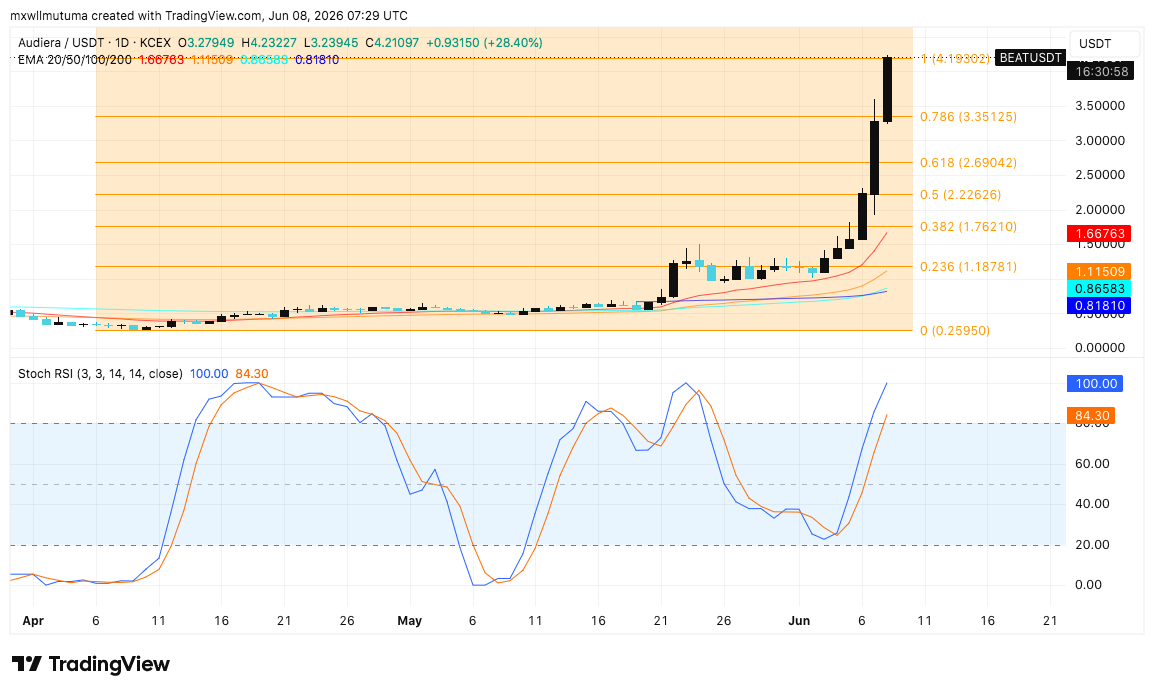
Daily TradingView snapshot (June 8, 2026) of Audiera (BEAT) showing the breakout toward its all‑time high and annotated Fibonacci resistance levels — useful to visualize momentum and key technical barriers. — Source: TradingView (snapshot by mxwllmutuma)
What Would Sustain A Breakaway Trend
Beyond technicals, sustained leadership in creator-economy tokens would likely require concrete execution milestones:
- Revenue visibility: Public dashboards or audits showing fee or royalty growth tied to real users.
- Distribution partnerships: Integrations with streaming, social, or creator tooling platforms that onboard non-crypto users.
- Payments simplicity: Fiat on-ramps, custodial options, and mobile UX that reduce friction for fans.
- Token demand sinks: Staking or utility that burns or locks supply as platform usage scales.
- Compliance posture: Clear terms on revenue-sharing, robust KYC/AML where needed, and IP verification flows.
- Multi-venue liquidity: Healthy depth across top exchanges, plus DEX pools with incentive plans that don’t dump emissions.
A leader can wobble and still decouple if it consistently posts fundamentals that the market can verify. In that sense, BEAT’s current run into prior highs is the starting audition, not the final verdict.
Comparing Creator-Economy Token Archetypes
| Archetype | Value Driver | Main Risk | Decoupling Potential |
|---|---|---|---|
| Revenue-linked utility | Platform fees/discounts, staking benefits | Regulatory scrutiny; fee cyclicality | Moderate to high if fees scale with users |
| Royalty/rights tokens | Programmable royalty streams | IP disputes; enforcement complexity | Moderate with verified catalogs |
| Fan tokens | Access, perks, community status | Engagement decay; churn | Low to moderate; reliant on campaigns |
| Tooling credits | Creator promotion and discovery | Platform competition; multi-homing | Moderate if network effects take hold |
The closer a token’s demand is tied to recurring platform usage — and the more defensible that platform is — the better its odds of holding up when majors wobble.
Crypto Daily will continue tracking BEAT’s liquidity profile, unlock calendar, and any disclosures on platform throughput. For ongoing coverage and market structure insights, visit Crypto Daily.
Frequently Asked Questions
Is BEAT’s rally just leverage, or is spot leading?
Watch the split between spot and perpetual futures volume, plus funding rates. A spot-led push with balanced or modest funding suggests stronger hands are buying; a perp-led move with aggressive positive funding often mean-reverts.
Which levels matter most right now for BEAT?
Market commentary has focused on the 1.0 Fibonacci area around ~$4.14 as resistance-turned-support and the prior ATH near ~$4.91, with $5 as a round-number magnet (Followin / BeInCrypto).
How do ETF outflows in BTC affect creator tokens?
They tighten system-wide liquidity and can raise correlations in stress. CoinShares reported ~$1.67B of ETP redemptions in a recent week, mostly from BTC products, which pressures benchmark liquidity (The Block reporting CoinShares).
What would signal a real decoupling?
Multiple weeks of relative strength across both down and up days in majors, sustained spot-led flows, stable funding, and evidence of fundamental traction like growing fees or active creators.
Are creator tokens more exposed to regulatory action?
They can be. Revenue sharing, royalties, and access features touch securities, IP, and consumer-protection concerns. Projects with clear disclosures, compliance processes, and IP verification are better positioned.
What is an example of rotation despite weak majors?
NEAR rallied ~30% on May 22 and over 50% across a month within an AI/creator-adjacent narrative, even as majors faced ETP outflows (The Block).
How should I size exposure to narrative tokens?
Conservatively. Consider smaller allocations than majors, add only on improving liquidity and fundamentals, and plan exits around unlocks and technical invalidations. Hedging with majors futures can isolate relative performance.
Disclaimer: This article is provided for informational purposes only. It is not offered or intended to be used as legal, tax, investment, financial, or other advice.
Credit: Source link