


For smart contract platforms, liquidity movements are one of the clearest signals of real on-chain activity.
The logic is simple: When large amounts of stablecoins like USDC or USDT move into a network or between protocols, it usually isn’t random.
Instead, it typically means participants are putting capital to work, deploying it into trading, liquidity pools, borrowing, or other on-chain strategies.
As shown in the chart below, Arkham Intelligence spotted Circle transferring over $4 billion in USDC to a Coinbase-linked address on HyperEVM (an Ethereum-style smart contract environment within Hyperliquid), marking one of the largest stablecoin transfers on record.
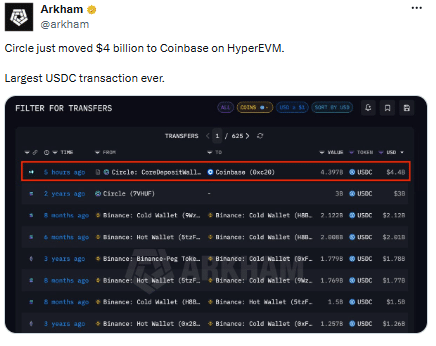
To put it into perspective, Circle issues USDC, while Coinbase plays a key role in distributing and managing it.
Notably, over 95% of Hyperliquid’s [HYPE] stablecoin supply is USDC, which is up 20% this month, bringing total USDC deployed on HyperEVM to over $6 billion, compared to just $192 million in USDT on the chain.
Against this backdrop, Circle’s $4 billion USDC transfer to a Coinbase-linked address becomes more meaningful, as it likely reflects “strategic” liquidity movement within the Hyperliquid ecosystem.
Now, to figure out if that’s actually the case, the key thing to look at is “timing.”
Large USDC flows prompt debate on Hyperliquid’s next growth leg
The timing of this $4 billion USDC transfer to Coinbase is far from random.
From a market perspective, momentum across risk assets continues to build. The recent SpaceX IPO has added to that momentum, drawing fresh attention to speculative assets.
Against this backdrop, activity on Hyperliquid has continued to accelerate, with perpetual futures open interest climbing above $8 billion.
Grayscale’s latest data further reinforces this trend. As shown in the chart below, Hyperliquid’s HIP-3 ecosystem has grown rapidly since launching in October 2025, reaching a peak Open Interest of $3.2 billion and generating over $200 billion in cumulative trading volume.
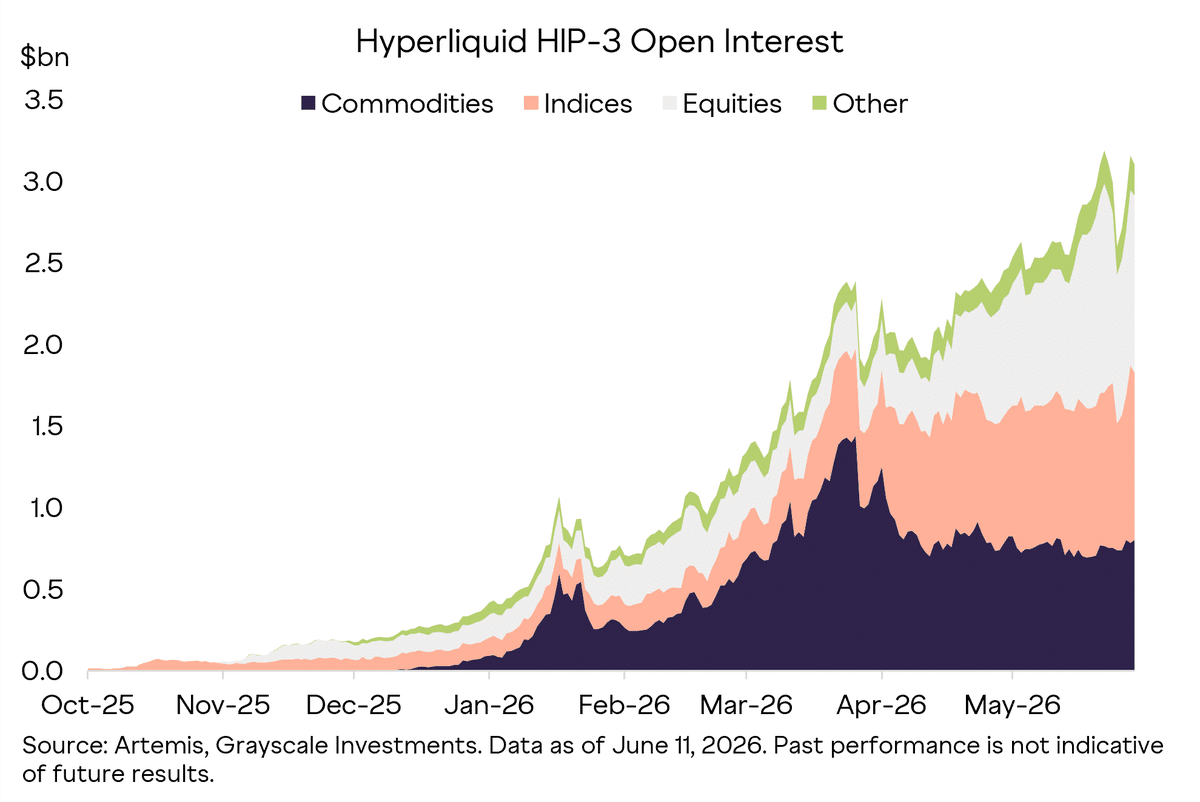
More importantly, this growth has coincided with Hyperliquid’s stablecoin supply jumping nearly 20% to a record $7.04 billion in early June.
That suggests liquidity is entering the ecosystem alongside rising trading activity, rather than traders simply increasing leverage on existing capital.
That naturally makes the $4 billion USDC transfer to a Coinbase-linked address on HyperEVM more significant. On its own, the transfer could look like routine fund movement.
But alongside rising stablecoin supply, Open Interest, and trading volume, it appears to support a broader trend of fresh capital flowing into the Hyperliquid ecosystem.
As a result, these flows act as a key catalyst for HYPE’s move into price discovery.
Final Summary
- The $4 billion USDC transfer suggests new liquidity is flowing into Hyperliquid.
- As trading activity and liquidity continue to grow, these capital flows could help drive HYPE’s next move in price discovery.
Credit: Source link