



Sono Group’s transition to a Bitcoin-heavy treasury is laying bare the severe financial strain at the core of the restructured company.
With its former solar energy subsidiary now spun out as a discontinued operation, the parent company generated zero revenue during the first half of 2026. Instead, Sono has tethered its survival entirely to digital assets.
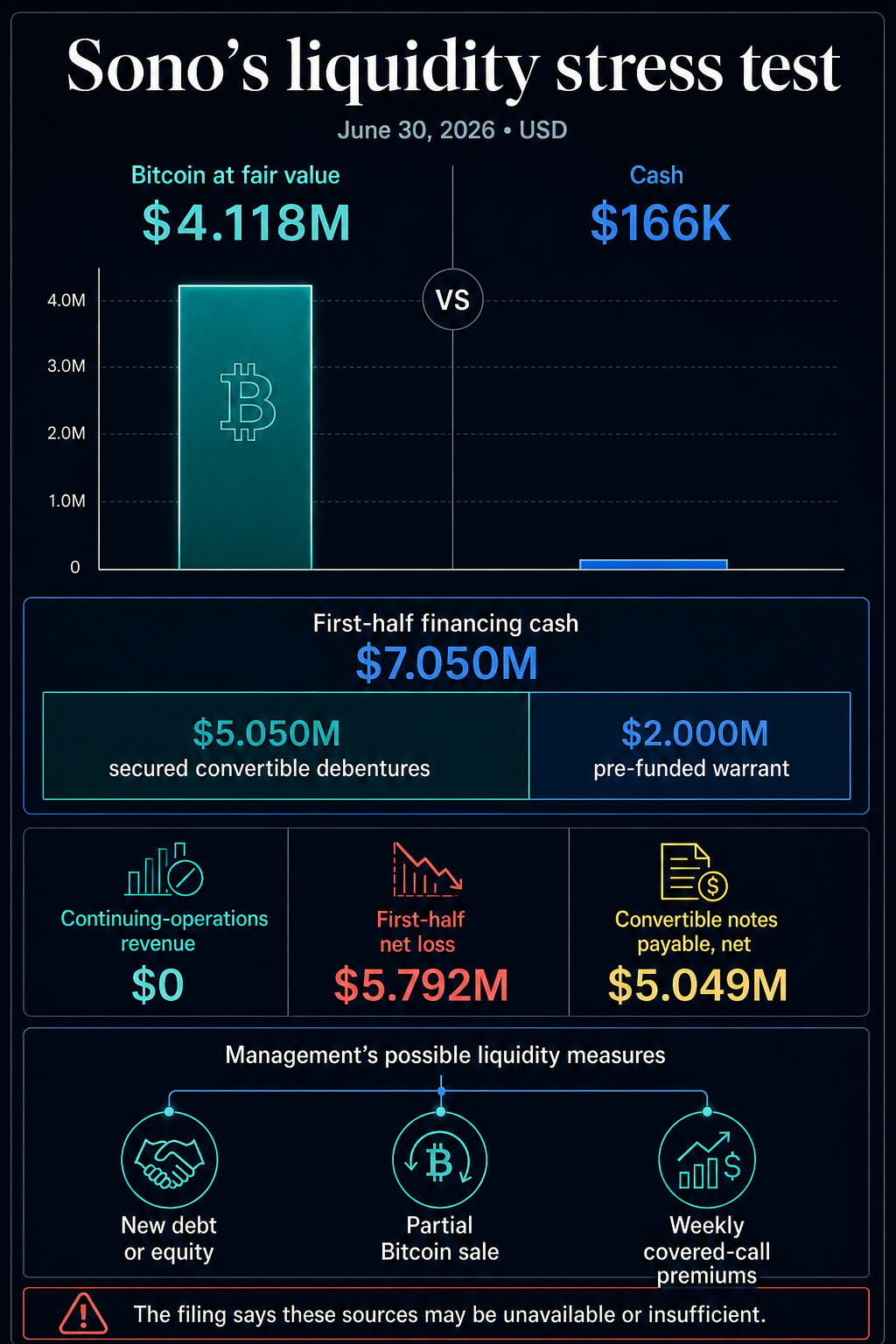
However, an Aug. 14 Form 10-Q filing reveals a stark liquidity mismatch: as of June 30, the company held just $166,000 in cash against $4.11 million in Bitcoin.

Bitcoin sits at the center of Sono’s liquidity plan
Bitcoin now occupies a central position in Sono’s continuing business accounts.
During the first six months of the year, the company spent $5 million to acquire 68.49 BTC. After accounting for option-related receipts and deliveries, its treasury stood at 69.78 BTC by the end of June. The firm stated that the fair value of these holdings stands at $4.118 million.
However, the strategy has yet to pay off as the company recorded an $890,000 net digital-asset treasury loss for the half.
To generate additional liquidity from the reserve, management has been writing weekly covered calls against its Bitcoin holdings. This strategy produced $93,000 of net option income during the first half, but the filing warns that those proceeds may not be sufficient to meet the company’s obligations.
Meanwhile, the financial pressure extends beyond the crypto portfolio.
Sono posted a $5.792 million net loss for the first half, including a $3.335 million loss from continuing operations.
The company has also relied heavily on external financing. First-half net cash provided by financing activities totaled $7.050 million, comprising $5.050 million of gross proceeds from four secured convertible debentures and another $2 million from a pre-funded warrant.
By June 30, Sono reported $5.049 million of convertible notes payable, net, against $5.050 million of gross principal outstanding. The net balance reflects accounting for the discounted debt host together with an embedded conversion derivative liability.

Those financing actions provided liquidity but did not resolve the underlying going-concern risk.
Sono says it plans to seek further debt or equity capital, while warning that additional financing may not be available on acceptable terms, or at all. Its covered-call strategy carries a similar limitation because premium income may not be enough to fund its obligations.
That leaves Bitcoin as both a treasury asset and a potential source of liquidity if other measures fall short.

Sono lists a partial Bitcoin sale among the measures available to shore up liquidity. The filing does not say such a sale has occurred or establish when one might happen.
But with no continuing-operations revenue and only $166,000 in cash as of June 30, the Bitcoin reserve has become more than a treasury investment: it is also one of the assets Sono may need to draw on to meet its obligations.
Credit: Source link

