



Tether is pursuing Xinbi Guarantee across its USDT payment network, freezing operational wallets as the sanctioned marketplace tries to keep transacting.
Blockchain analytics firm Bitrace said on Sept. 9 that more than $45 million in USDT had been frozen across at least 22 operational addresses linked to Xinbi, including wallets used to receive, route, and withdraw funds.
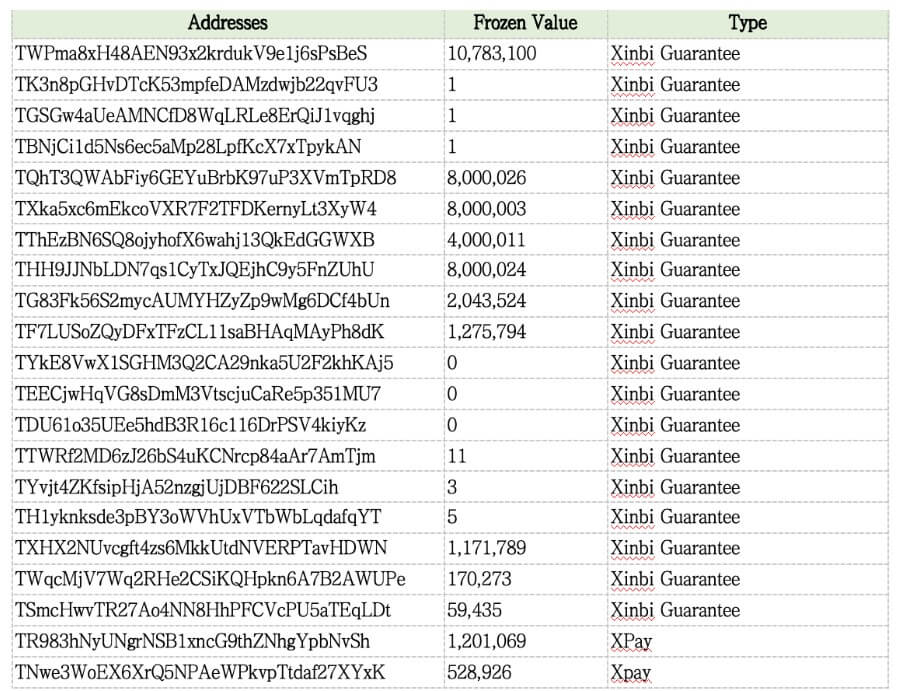
The action targets a network already under government scrutiny. The UK sanctioned Xinbi Guarantee in March, identifying it as a major Chinese-language crypto marketplace and money-laundering hub serving Southeast Asian scam compounds.
Tether targeted Xinbi’s USDT infrastructure
The $45 million freeze reached beyond wallets simply holding Xinbi-linked funds.
Bitrace said the targets included recently used deposit, intermediary, and withdrawal addresses, outgoing hot wallets operated by Xinbi payment service Xpay, and wallets belonging to third parties with close financial ties to the marketplace.
That breadth suggests the action aimed to disrupt Xinbi’s ability to move money, rather than only immobilizing assets already sitting in known addresses.
Bitrace contrasted the operation with a 2024 action against Huione Group, when about $29.6 million was frozen in a single address while other operational wallets remained usable. In Xinbi’s case, restrictions spread across the infrastructure used to receive deposits, route funds, and process withdrawals.
Xinbi responded by activating new operational addresses, but those replacements provided only a brief escape.
Bitrace said newly activated wallets were frozen again on the evening of Sept. 8, less than 12 hours after the initial action. One replacement business address moved about 1.8 million USDT before another restriction was imposed, leaving roughly 37,839 USDT stranded.
Meanwhile, the enforcement perimeter also extended beyond wallets directly attributed to Xinbi.
Bitrace said third-party operators with financial links to the marketplace were caught in the freezes, including one OTC operation that processed more than $72 million over the preceding year and another whose deposits through Xinbi totaled less than $850,000.
These actions show how Tether has increasingly incorporated freezing capability into its law-enforcement efforts.
The company said in April that it works with more than 340 agencies across 65 countries, while its T3 Financial Crime Unit with Tron and TRM Labs had frozen more than $450 million in illicit assets by May. Data from Stable.rip shows that the firm has blacklisted more than $4 billion in USDT.
Tether’s wallet pursuit pushes Xinbi into ‘unfreezable’ USDD
With replacement USDT wallets being frozen within hours, Xinbi has shifted its response from changing addresses to changing stablecoins.
Bitrace reported that the marketplace told users Tether’s actions prompted it to support only USDD transactions going forward, redirecting deposits to USDD rather than continuing to rebuild payment rails around USDT.
USDD is a US dollar-denominated stablecoin with roughly $1.5 billion in circulation across the Tron and Ethereum blockchains.
The switch directly targets the mechanism Tether used to disrupt Xinbi’s operations.
USDD describes itself as an overcollateralized decentralized stablecoin that operates without a central issuer capable of blacklisting individual holders. Its documentation says the token is “tamper-proof and cannot be frozen,” removing the address-level control Tether repeatedly exercised against Xinbi’s USDT wallets.
For Xinbi, that feature has moved from a design principle to an operational advantage. Even if investigators identify its next payment address, they cannot simply repeat the same token-level freeze that disabled the USDT held in earlier wallets.
On-chain activity suggests Xinbi had already begun experimenting with alternative routes. Bitrace-linked analysis identified Xinbi-related funds moving through Tron’s JustLend protocol and jUSDT, while other flows passed through decentralized exchanges and cross-chain infrastructure before accumulating USDD.
The migration creates a new constraint for an enforcement campaign that became increasingly effective while Xinbi remained dependent on Tether.
Tether can blacklist USDT as Xinbi moves from one identified wallet to another. However, it cannot impose the same restriction directly on USDD, meaning the contest now shifts from freezing the stablecoin itself to disrupting the infrastructure around it.
Still, that does not put Xinbi beyond reach. USDD may resist address-level freezes, but acquiring, exchanging, and ultimately cashing out the token can still require interaction with centralized exchanges, bridges, OTC desks, and other services vulnerable to law-enforcement pressure.
The next phase of the crackdown will therefore test whether Xinbi can rebuild a functioning payment network around USDD faster than investigators can target the services and counterparties that make that network usable.
Credit: Source link