



Key Takeaways
- Goldman Sachs moved from a hold call to a 25-basis-point hike for Sept. 16 after August core CPI hit 0.3%.
- CME Fedwatch odds for a September increase climbed from roughly 69% to 86.5% within hours of the data.
- Bitcoin’s 50-day average crossed above its 200-day line on Sept. 11, then slipped back under the same day.
The Reversal
As recently as July 31, Goldman Sachs was the loudest institutional voice arguing the Fed would sit still. The bank expected rates to stay unchanged for the remainder of the year, reading Chair Kevin Warsh’s remarks as less hawkish than the dissent count implied and betting that monthly core inflation would soften enough for officials to tolerate above-target annual readings.
That call, however, is gone as researchers for the bank, led by chief U.S. economist David Mericle, now expect the Federal Open Market Committee (FOMC) to deliver a quarter-point increase when its two-day meeting concludes on Sept. 16, lifting the federal funds target from its current 3.50% to 3.75% range.
Goldman is not alone in this, given JPMorgan, Citigroup, Mitsubishi UFJ and TD Securities have all landed on the same side.
Infact, the Wall Street Journal went further, reporting that investors have all but concluded the Fed will raise rates next week for the first time in three years, with attention already moving past the decision itself and onto what follows.
What the Data Did
August’s core consumer price index (CPI) inflation, which strips out food and energy, rose 0.3% month-on-month against a 0.2% consensus. A tenth of a percentage point does not sound like much, and analysts had said in advance that 0.2% favored a hold while 0.3% favored a hike.
CME’s Fedwatch tool had the probability of a quarter-point increase at roughly 69% immediately after the release. Those odds spiked to 86.5% by the end of the session, and broader market pricing has since drifted toward 90%.
The bar had already been lowered before the print, with Chase noting in August that slower-than-expected normalization of supply chains around the Strait of Hormuz, combined with markets questioning the Fed’s inflation-fighting credibility after the July meeting, made a September move easier to justify.
The Signal That Almost Fired
Bitcoin’s chart came close to telling a very different story the same day as its daily 50-day exponential moving average (EMA) briefly pushed above the 200-day EMA, the crossover traders call a golden cross and treat as confirmation of a trend change. By the close, it had slipped back underneath.
The four-hour chart has held its own golden cross since late August, and trend strength on the daily remains firm, with an average directional index reading of 45. What failed was the confirmation, not the trend.
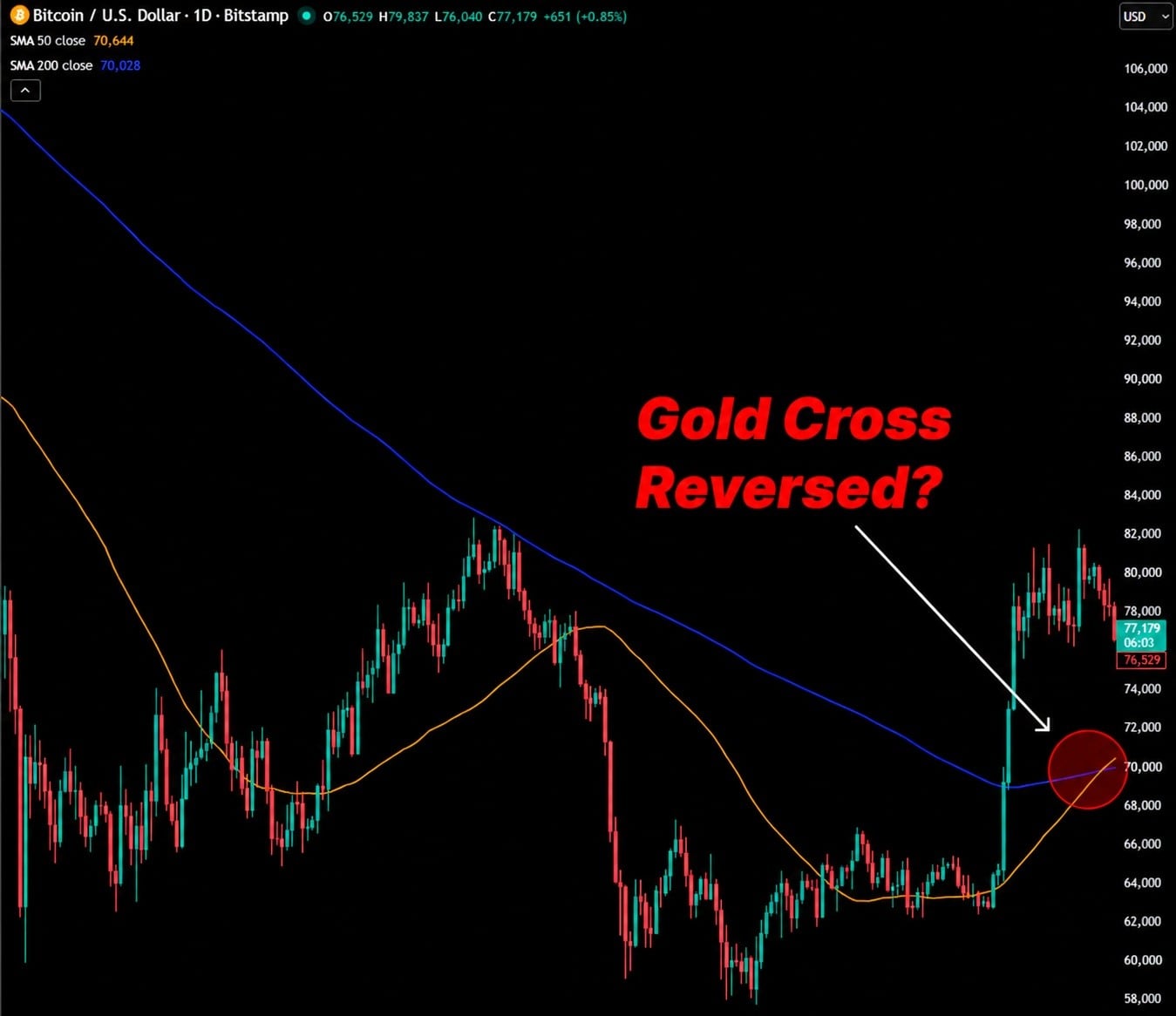
The timing was not coincidental either, as bitcoin ran to an intraday high of $79,505 earlier today before fading to its current range of $77,200, and a rate hike generally precedes a risk-off rotation.
Bitcoin’s price has now failed at the $80,000 level repeatedly this month, and each failure has coincided with hawkish repricing rather than with anything specific to crypto.
The Path, Not the Print
The more consequential question is what comes after Sept. 16 because almost no one at the central bank believes a single 25-basis-point increase does much on its own to curb inflation, which is precisely why a hike next week would signal that officials view current rates as too low and may act again.
Bitcoin.com News flagged three dates this month as the gates standing between bitcoin’s price and a resolution of its range. Two have passed and both broke hawkish. Only the FOMC is left, and the market has already priced the outcome at close to nine-in-ten.
That leaves an unusual setup given the hike itself is largely in the price. What is not priced is the path, and a Fed that signals a series rather than a one-off would give the golden cross that flickered on Sept. 11 very little chance of firing again this month. Interesting week ahead!
Credit: Source link