



CoinStats API is the strongest all-round choice for developers who need balances, DeFi positions and profit and loss from a single key. Codex suits real-time trading apps, and GoldRush suits teams that want deep multichain history. The other five APIs in this review each win a narrower brief. Allium serves finance and compliance teams, and Nansen API adds wallet intelligence. Blockscout PRO API covers EVM explorer data, Blockchair handles Bitcoin-family lookups, and thirdweb API fits apps that also create wallets for their users.
A wallet API is a dependency you live with for years. It sits under every balance, chart and alert your users see, and swapping it later means rewriting parsers, caches and tests. Providers also disappear. Dune retired Sim, its realtime wallet API, on August 1, 2026, giving teams 75 days’ notice and naming Codex as a migration partner. Picking the best crypto wallet API therefore comes down to fit and longevity. That is why this review compares all 8 options against their official documentation and pricing pages rather than marketing claims.
Demand for this data is not in question. a16z crypto’s State of Crypto 2025 report counts 40 to 70 million active crypto users, an estimated 716 million owners and roughly 181 million monthly active addresses. The same report put mobile wallet users at an all-time high, up 20% year on year. Usage also held up through the 2025 to 2026 downturn: Chainalysis found onchain economic activity slipped just 1.6% while total market cap fell about 50%.
“Activity has become consistent, routed through wallets in a steady rhythm rather than in bursts,” says Philip Gradwell, vice president of economics at Tether, in Chainalysis’ 2026 Geography of Crypto report.
This guide covers wallet data APIs, the read side of crypto: services that turn a public address into balances, transaction history, DeFi positions and PnL. Tools that create or custody wallets for end users belong to a different category and are only covered here where a provider does both.
Wallet API comparison table
|
#
|
API
|
Best for
|
Free tier
|
Entry plan
|
|---|---|---|---|---|
|
1
|
CoinStats API
|
Portfolio trackers, tax tools and wallet apps
|
20,000 credits/month
|
Starter, $49/month
|
|
2
|
GoldRush
|
Multichain wallet history, Bitcoin included
|
14-day trial
|
Vibe Coding, $10/month
|
|
3
|
Codex
|
Real-time trading apps, bots and AI agents
|
10K requests/month ($1 signup)
|
Growth, from $350/month
|
|
4
|
Allium
|
Finance, accounting and compliance data
|
Not publicly listed
|
Pay per call, $0.03 per wallet call
|
|
5
|
Nansen API
|
Wallet labels and smart-money context
|
100 credits, then 10/day
|
Pro, $49/month billed annually
|
|
6
|
Blockscout PRO API
|
EVM explorer data on a budget
|
100,000 credits/day
|
Builder, $49/month
|
|
7
|
Blockchair
|
Bitcoin-family address lookups
|
1,000 calls/day, short trial
|
Not publicly listed
|
|
8
|
thirdweb API
|
Apps that also create wallets for users
|
No $0 plan listed
|
Growth, $99/month
|
Pricing and limits change often, so check each provider’s pricing page before committing to a plan.
What a crypto wallet API does, and why one address is never one lookup
A crypto wallet API turns a public address into a readable portfolio. It answers three questions: what a wallet holds, what it has done and what it is worth. The difficulty is that a wallet never lives in a single place, and each major chain family stores balances differently.
On EVM chains, Ethereum has two account types, externally owned accounts and contract accounts, and the same address can hold funds on every EVM-compatible network. One address can therefore mean dozens of lookups across Ethereum, Base, Arbitrum and the rest. On Solana, tokens do not sit on the wallet address at all. Solana’s token docs require a separate token account for every token a wallet holds, so the API has to find and sum those accounts. Bitcoin wallets spread funds across many derived addresses, and the BIP-32 standard lets one extended public key, the xpub, reveal them all. The same specification warns that xpubs need more care than regular public keys because they expose a wallet’s full history.
A good wallet API hides all of this behind a handful of calls. Your application asks about a wallet, not about chains, token accounts and derivation paths.
Wallet API versus RPC node: the same address, two very different answers
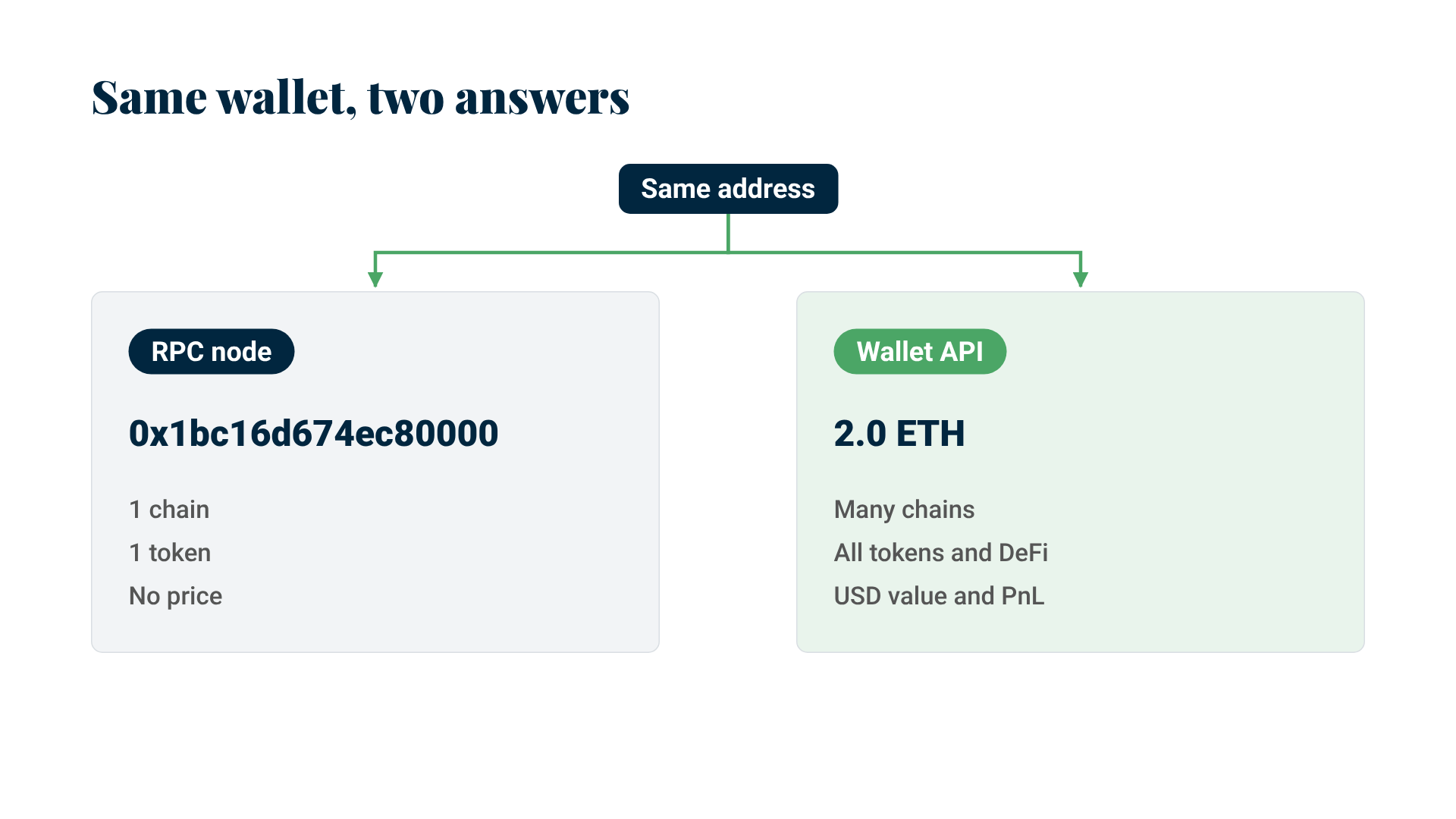
An RPC node returns raw chain state, while a wallet API returns a portfolio. RPC, short for remote procedure call, is the direct line into a blockchain node, and it is what most developers reach for first.
Ask a node for an ETH balance and it answers with a hex string such as 0x1bc16d674ec80000. That value means 2 ETH, on one chain, with no price attached. Every token, every chain and every DeFi protocol then needs its own query and its own parser. “Today, wallets trust their RPC providers to tell them any information about a chain,” wrote Vitalik Buterin, co-founder of Ethereum, in his December 2024 post on wallets.
A wallet API adds the missing layers: indexing, pricing and protocol decoding. An indexer reads every block and stores the result in a searchable database, and building that in-house means running indexers per chain and keeping protocol decoders current as DeFi contracts change. Most production apps end up using both layers, with the node broadcasting transactions and the wallet API serving everything users read.
How the eight wallet APIs were evaluated
Every API in this review was judged on six criteria, using official documentation and pricing pages only. No figure comes from a reseller or a third-party roundup.
-
Coverage: chains served, with Bitcoin and Solana checked separately.
-
Data depth: balances, transaction history, DeFi positions and PnL.
-
Freshness: streaming or webhooks, versus polling for changes.
-
AI readiness: an official MCP server. MCP, the Model Context Protocol, lets AI agents call an API as a tool.
-
Pricing clarity: a public free tier and a public entry price.
-
Liveness: a recent changelog and no sunset notice.
Coverage carries the most weight because developers rarely stay on one chain. Electric Capital’s 2024 developer report found that one in three crypto developers now work across multiple chains, and L2BEAT tracks nearly 100 scaling projects. “In an L2 scaling world, users are going to exist on lots of L2s,” Vitalik Buterin wrote in 2023, and wallet data has to follow them.
Liveness earned its own criterion after Sim. An API with no recent changelog is a risk however good its documentation looks, so node-only RPC providers were excluded, as were pure wallet-as-a-service tools. MCP support, meanwhile, is now table stakes: seven of the eight APIs below ship an MCP server, and the real difference between them is the data underneath.
CoinStats API: one key for balances, DeFi positions and PnL
CoinStats Wallet API reads 120+ blockchains through a single schema and returns balances, transactions and DeFi positions for any public address. Prices come bundled, covering 100,000+ coins across 200+ exchanges, so there is no second provider to integrate for valuations. It is the natural fit for portfolio trackers, tax tools and wallet apps that need the whole picture rather than one slice of it.
DeFi detection covers staking, lending and liquidity pool positions across 10,000+ protocols, and profit and loss is built in, realized and unrealized, with cost basis. Bitcoin wallets load through xpub, ypub or zpub keys, and Solana is supported alongside the EVM networks. A Token Risks endpoint flags risky contracts before users interact with them. An official MCP server exposes 20+ wallet, DeFi and portfolio tools to AI agents, and the same key also covers centralized exchange balances and market data. A separate wallet API comparison on the CoinStats blog documents each endpoint in more detail.
The gaps are on the push side. There are no webhooks or streams, so applications poll for updates, and DeFi positions require a paid plan. Credits are also worth modelling before you commit: a balance call costs 40 credits per chain, all-chain queries cost ten times that, and the free tier offers 20,000 credits a month. The Starter plan is $49 a month for 1 million credits.
GoldRush: multichain wallet history, Bitcoin HD wallets included
GoldRush is the wallet API formerly sold as the Covalent API, and it remains the best-known name in this category, with the company citing 70,000+ developers. It covers 100+ chains, Bitcoin and Solana included, and its endpoints return current balances, historical balances, transactions and token prices. Bitcoin lookups handle HD wallets, which derive many addresses from a single seed, something few multichain APIs do well.
A GraphQL WebSocket API streams live updates, an official MCP server ships 50+ tools for AI agents, and a CLI plus the @covalenthq/client-sdk package cover local development. What GoldRush lacks is a DeFi positions endpoint, and its PnL support is only partial, so portfolio apps that need decoded staking or liquidity positions will need a second source.
The free option is a 14-day trial with 25,000 credits rather than an ongoing tier. The entry plan, Vibe Coding, is $10 a month for 10,000 credits, which runs out quickly at production volumes; the next tier, Professional, is $250 a month.
Codex: real-time token data for trading apps, bots and AI agents
Codex is the real-time data layer that trading and portfolio apps run on. One API returns production-ready values: live USD prices, OHLCV charts, holder analytics, and wallet balances across 90M+ tokens and 80+ networks (EVM, Solana, and more), all in one schema. It also covers prediction markets (Polymarket, Kalshi, and more) through the same API, if your product touches event trading.
Coverage and speed are the strengths. 1-second data freshness, WebSocket subscriptions (99.9% uptime), and webhooks for live price and trade feeds, over GraphQL with a TypeScript SDK and an MCP server for AI agents. It powers TradingView, Coinbase, and Uniswap.
The scope is on-chain data, not a full wallet stack. Codex indexes DEX/on-chain token data and prediction markets rather than decoded DeFi positions (LP tokens, staking), centralized-exchange balances, or non smart-contract blockchains like Bitcoin, so pair it with a portfolio layer like CoinStats for those. Where it wins is the depth and speed of the token and prediction-market data underneath a portfolio.
Pricing starts with a free tier of 10K requests a month after a one-time $1 signup, and the Growth plan is $350 a month for 1 million requests. Note that the wallet balances query and WebSocket access sit on the Growth plan and above.
Allium: realtime APIs and SQL on the same dataset for finance teams
Allium pairs realtime REST APIs with a SQL warehouse built on the same data. That combination appeals to finance, accounting and compliance teams, because auditors can query exactly what the application shows. Wallet endpoints return balances, historical balances, transactions and PnL, with enriched activity labels such as swap, transfer and bridge. Its live chain list shows 22 realtime chains, Bitcoin and Solana included.
DeFi positions are in beta on 14 of those chains. Datastreams push data into Kafka, Pub/Sub or SNS pipelines, and an official MCP server connects AI agents. Allium also published a Sim migration guide after Dune’s shutdown notice, which says something about where it sees its market.
The drawback is transparency. Subscription pricing and any free tier are not public, so expect a sales conversation for volume plans. Pay-per-call access is available at $0.03 per wallet call, billed in USDC at 3 requests per second, which is enough to evaluate the data before that conversation.
Nansen API: wallet labels and smart-money context
Nansen API tells you who a wallet is, not only what it holds. Its profiler endpoints return balances, transactions, counterparties, related wallets and PnL. Nansen’s labels then add entity and smart-money context to raw addresses, a capability the rest of this list does not offer. Balance and transaction endpoints cover 25+ chains, Solana and Bitcoin included, and DeFi holdings and perpetual futures positions are available too. Smart Alerts can post realtime events to a webhook of your choice.
The free tier is small: 100 trial credits, then a daily top-up to 10. A label call costs 100 credits, PnL does not cover Bitcoin, and the official MCP server bills its calls against the same credits. The Pro plan is $49 a month when billed annually, or $69 month to month. Nansen therefore works best as a labels layer paired with a cheaper balances API, rather than as the only data source.
Blockscout PRO API: explorer-grade EVM data on a budget
Blockscout is an open-source block explorer, and its PRO API puts 100+ EVM chains, testnets included, behind a single key. Address endpoints cover token balances, transactions, token transfers and internal transactions, a WebSocket API streams balance and transfer events per address, and CSV exports help with accounting work. An official MCP server is available for AI agents, and the API follows the explorer-API format most EVM developers already use, which keeps migration simple.
It is EVM-only, so Bitcoin and Solana are out, and there are no DeFi positions or PnL. The free tier is generous at 100,000 credits a day, though default calls cost 20 credits each, so that works out to about 5,000 calls a day. The Builder plan is $49 a month for 100 million credits.
Blockchair: Bitcoin-family address lookups
Blockchair is a block explorer API built for UTXO chains like Bitcoin, where coins are tracked as unspent outputs rather than account balances. Its API answers on 14 mainnets, although older documentation still lists 17. Address endpoints return balances and transaction history, and an xpub endpoint, still in beta, rolls up Bitcoin-style HD wallets.
There is no DeFi, PnL, Solana, streaming or MCP server, and the public API changelog is rarely updated, so treat it as a specialist Bitcoin tool rather than a platform. The free tier of 1,000 calls a day is offered as a short trial, and paid pricing sits on a dynamic plans page rather than a fixed list. Check current rate limits directly, since Blockchair’s own pages disagree with each other.
thirdweb API: wallet data for apps that also create wallets
thirdweb pairs in-app wallets with indexed wallet data under a single SDK, which is the reason to choose it. Its older Insight API is archived, and wallet reads now live in the thirdweb API, with endpoints for balances, tokens with prices, transactions and NFT holdings across 100+ chains. Webhooks and an official MCP server are included, and SDKs cover TypeScript, React, React Native, .NET, Unity and Unreal.
There are no historical balances, DeFi positions, PnL or Bitcoin support, and Solana coverage stops at balances. The pricing page shows no $0 plan. The Growth plan is $99 a month with 1 million data queries included and $8 per million after that. The first 1,000 wallet users are free, then cost $0.015 per monthly active user.
Benchmarks: chain coverage, capabilities and entry pricing compared
These charts use each provider’s own published figures. They compare documented features and prices, not live latency.
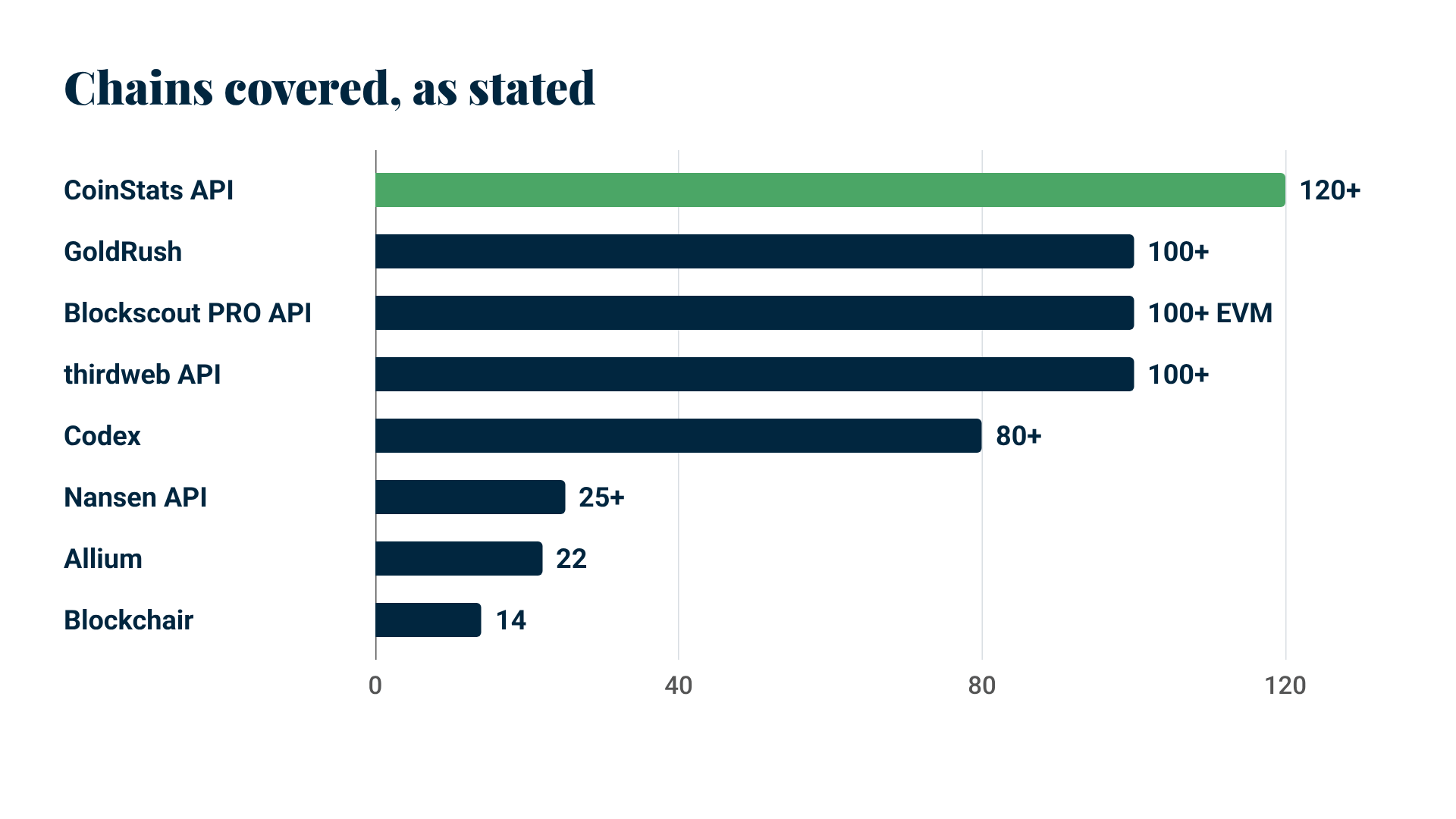
CoinStats API leads on stated chain count with 120+, followed by GoldRush, Blockscout PRO API and thirdweb API at 100+. Allium and Nansen API cover fewer chains but add SQL access or labels that the broader APIs do not have. Chain count is never the whole story, however, so check that your top five chains support every endpoint you need before you sign up.
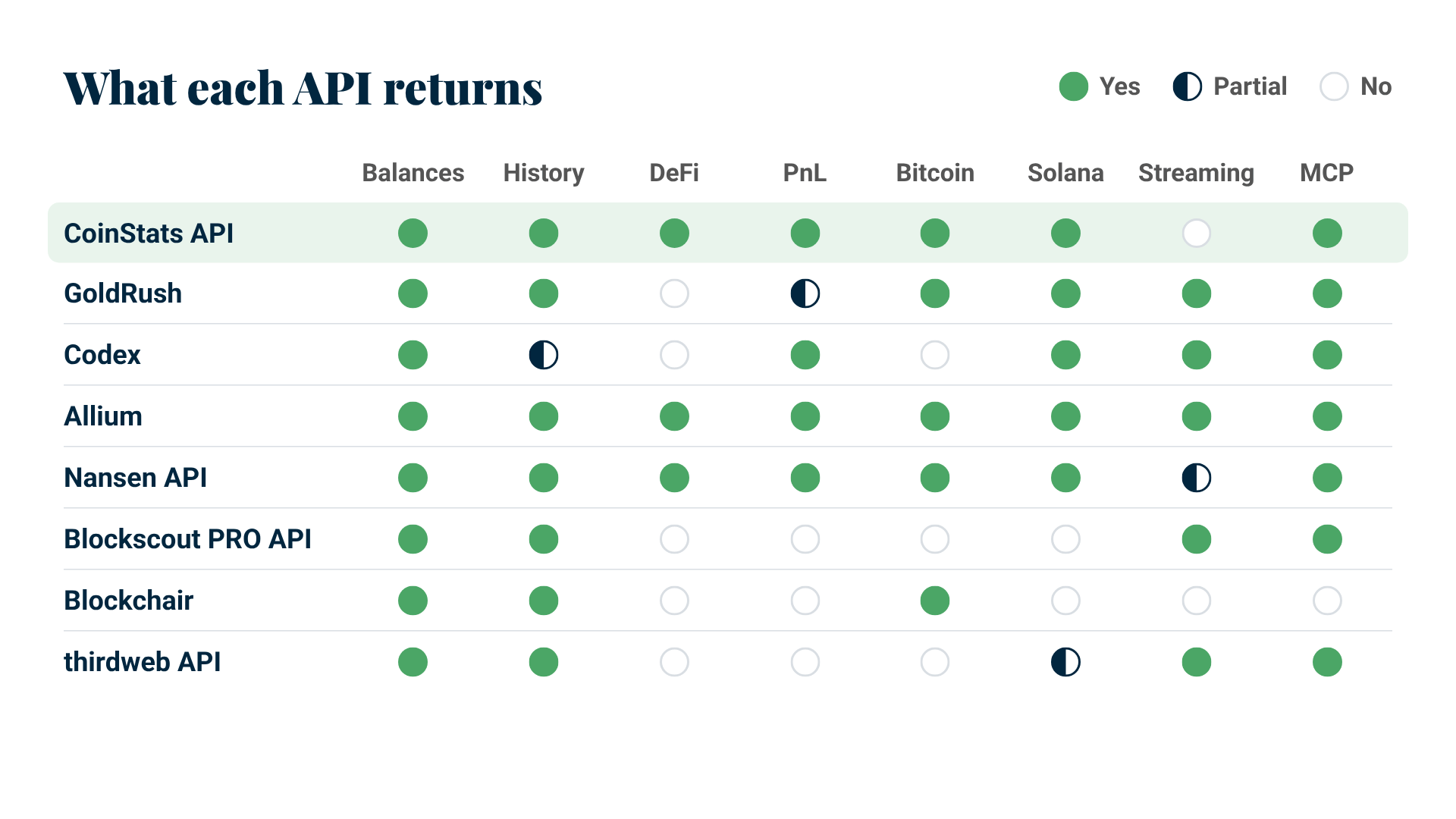
Every API here returns wallet balances, so the field splits on DeFi positions and PnL. Only CoinStats API, Allium and Nansen API return both. Streaming is the other divide: GoldRush, Codex, Allium, Blockscout PRO API and thirdweb API push updates, Nansen API pushes alerts, and CoinStats API and Blockchair need polling. In the matrix below, partial means limited scope, such as thirdweb’s balance-only Solana support.
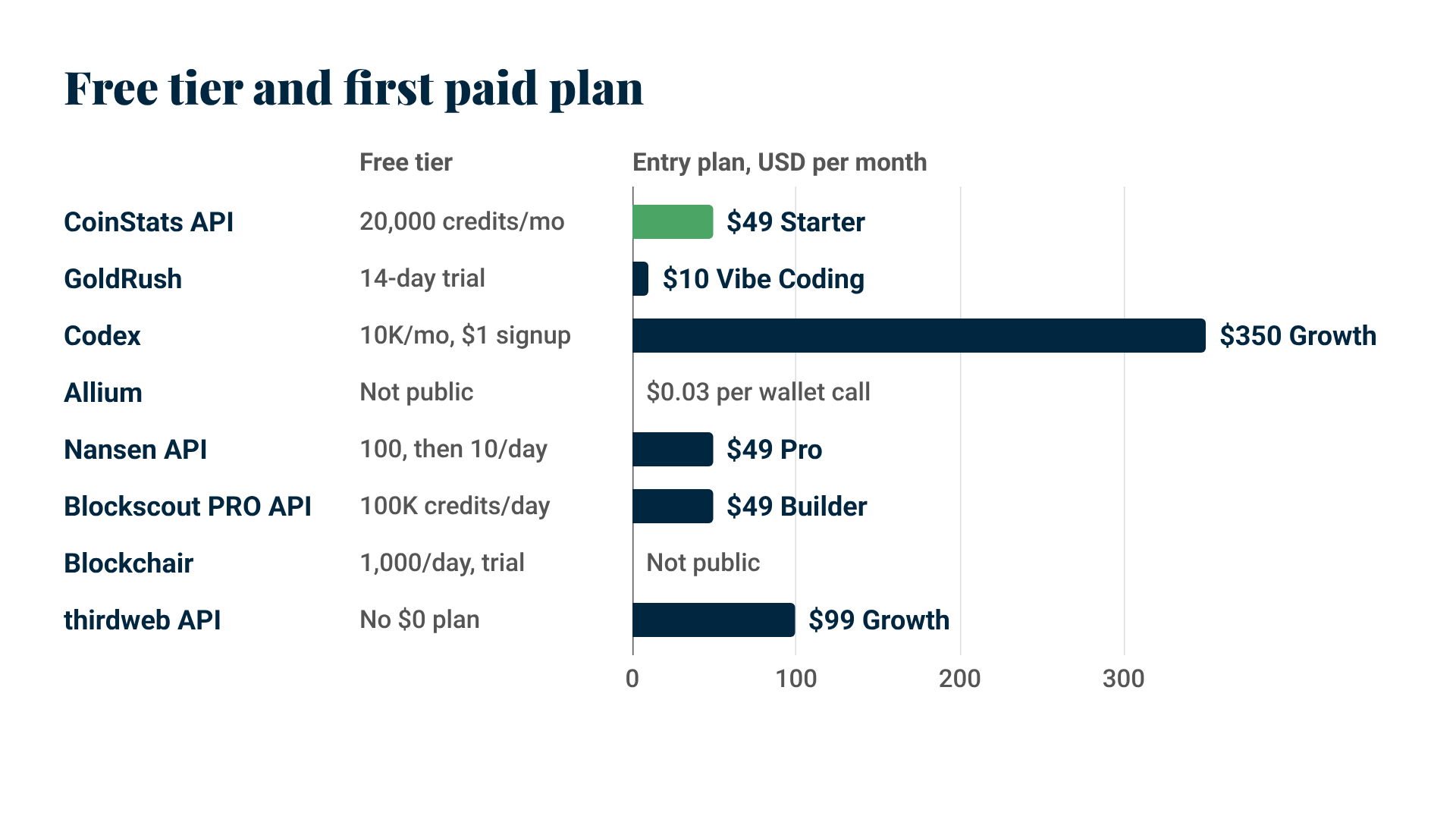
Entry plans run from $10 to $350 a month, and free tiers vary even more, from one-time credits to daily allowances. Credits are not comparable across providers because each one prices a call differently, so model your real call mix before comparing plans. Nansen’s $49 figure is billed annually.
Which wallet API fits your build
Start from the product you are building, then match the API to it.
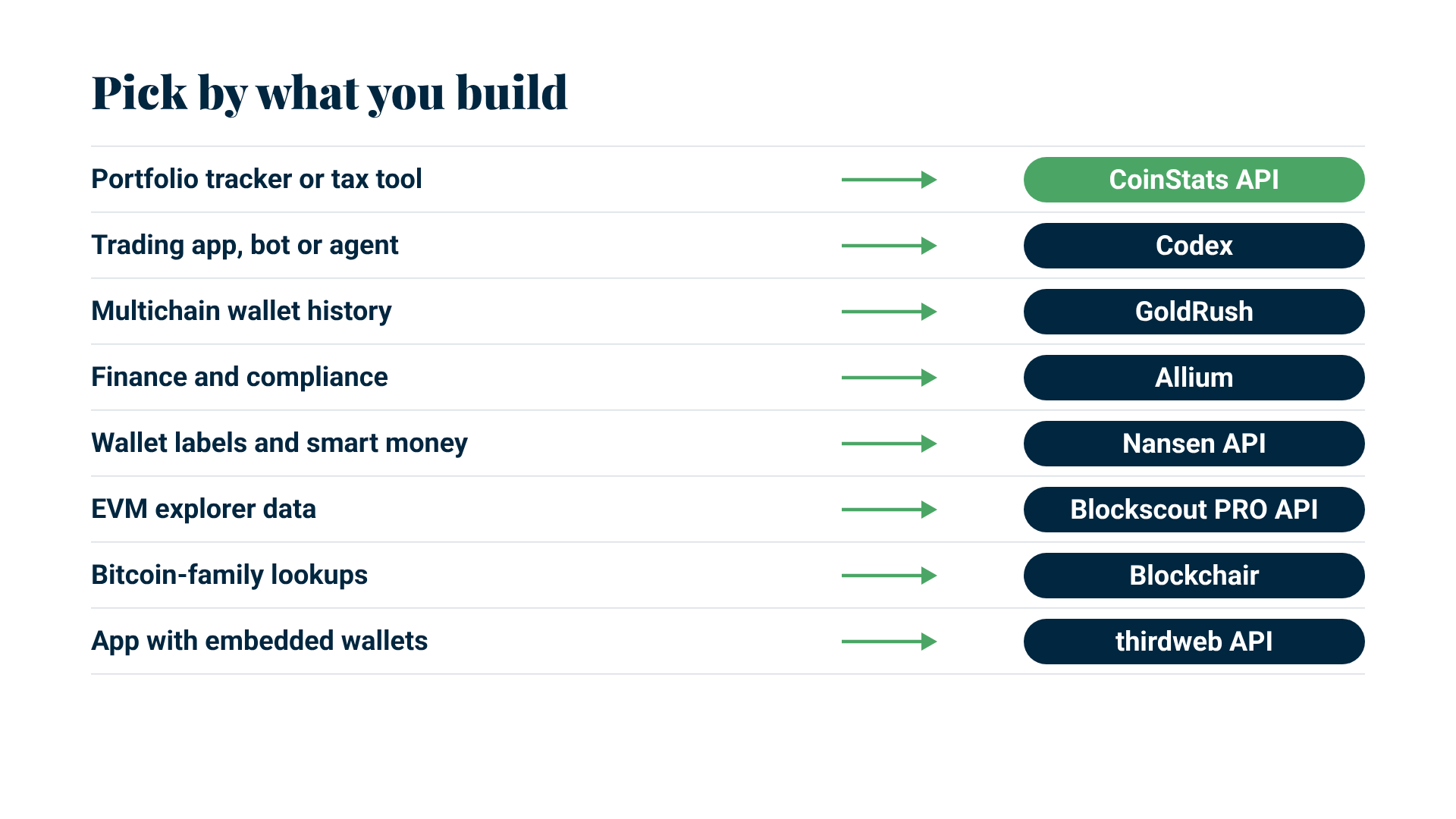
Portfolio trackers and tax tools should start with CoinStats API, because balances, DeFi positions and PnL with cost basis come from one key. Exchange balances ride on the same key, which tax tools need. Trading apps, bots and AI agents are better served by Codex for live token prices, trades and WebSocket feeds, paired with a portfolio layer for DeFi positions.
Wallet apps that add in-app swaps need two decisions, not one. The read side is covered by CoinStats API or thirdweb API, with thirdweb adding in-app wallets and CoinStats adding DeFi and PnL. The swap side needs a venue, and the venue decides fees, custody and which chains users can reach; this comparison of crypto swap exchanges breaks those trade-offs down.
Finance, accounting and compliance teams should look at Allium when auditors need SQL access to the same data the app reads. Blockscout PRO API’s CSV exports are a lighter option for EVM-only books. Research and wallet intelligence products should pick Nansen API for counterparty labels and smart-money tracking, layered over any balances API. Bitcoin-heavy apps can use CoinStats API or GoldRush, which both read xpubs alongside many other chains, while Blockchair is the budget pick for Bitcoin-family lookups only.
Some applications need more than wallet reads. This ranking of the best crypto APIs covers RPC providers, trading venues and oracle feeds for the rest of the stack.
Mistakes to avoid when integrating a wallet API
-
Plan your exit on day one. Sim users got 75 days to migrate. Keep provider calls behind your own interface so that a swap touches one module.
-
Size plans with real call costs. Credit prices differ by endpoint, and DeFi and xpub calls cost far more than balance calls.
-
Treat xpubs as sensitive data. BIP-32 notes that an xpub exposes every transaction in a wallet, so never log one or send it to analytics.
-
Never ask users for private keys. Chainalysis counted 158,000 personal wallet compromises in 2025, affecting 80,000 victims, and a read-only wallet API needs public addresses only.
-
Cache what never changes. Confirmed transactions stay fixed, so store them once and refresh balances instead.
-
Check coverage chain by chain. A headline chain count can hide endpoints that skip the chains you need.
Frequently Asked Questions
What is a crypto wallet API?
A crypto wallet API turns a public wallet address into structured data: balances, transaction history and, with the better providers, DeFi positions and PnL. Applications use it to show portfolios without running their own blockchain indexers.
Which crypto wallet API is best?
In this review, CoinStats API ranks first as the all-in-one pick across 120+ chains, with Codex leading for real-time trading data and GoldRush for deep multichain history.
Is there a free crypto wallet API?
Yes. CoinStats API includes 20,000 free credits a month across 120+ chains. Blockscout PRO API gives 100,000 credits a day on EVM chains, and Codex offers 10K requests a month after a $1 signup.
What is the difference between a wallet API and an RPC node?
An RPC node returns raw chain state one query at a time, while a wallet API indexes, prices and decodes that data into a portfolio. Many apps use a node for broadcasting transactions and a wallet API for everything users read.
Can a wallet API read Bitcoin wallets?
Yes, if it supports extended public keys. CoinStats API, GoldRush and Blockchair read xpubs, and Allium and Nansen API cover Bitcoin addresses too.
Do crypto wallet APIs work with AI agents?
Most do, through MCP, the Model Context Protocol that AI agents use to call tools. Seven of the eight APIs here ship an MCP server, with Blockchair the exception.
How do I integrate a crypto wallet API?
Get an API key, then call the balances endpoint with a public address. Cache transaction history, poll or stream balances, and wrap the provider behind your own interface so that any future migration stays inside a single module.
Conclusion
CoinStats API is the broadest single key in this review, pairing 120+ chains with DeFi positions, PnL and Bitcoin xpub support. Codex is the pick for real-time trading data and GoldRush for deep multichain history, while Allium and Nansen API add SQL access and wallet intelligence on top of the basics.
Whatever you choose, check liveness first. Sim’s shutdown showed how fast a dependency can disappear, and the free tier of CoinStats API is a low-cost way to test any of these claims against your own wallets before committing.
Disclaimer: This article is provided for informational purposes only. It is not offered or intended to be used as legal, tax, investment, financial, or other advice.
Credit: Source link