

A new free heatmap replaces the usual leverage assumptions with roughly 39,000 open positions read directly from Hyperliquid.
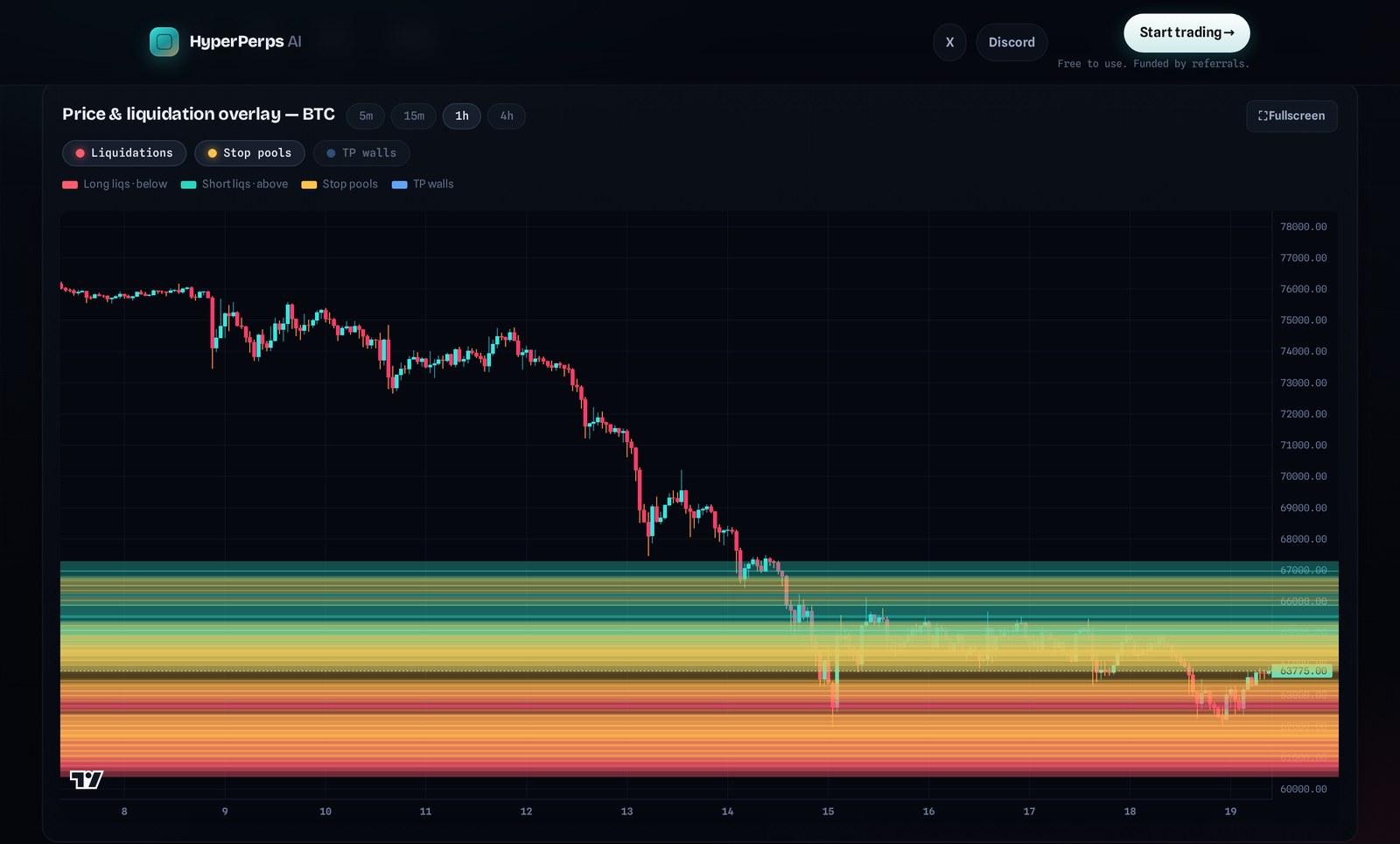
The HyperPerps liquidation heatmap: live BTC price on Hyperliquid over long-liquidation clusters (red), short-liquidation clusters (teal) and stop-loss pools (amber). Source: hyperperps.app
November 2026 — Most liquidation heatmaps in crypto share a quiet limitation: they do not know where traders’ liquidation prices are. They infer them. HyperPerps, a developer of trading tools for Hyperliquid, has released a free heatmap that takes a different route, building its map from real open positions rather than a statistical model.
The tool covers Hyperliquid’s BTC, ETH, SOL and HYPE perpetual markets and is live at https://hyperperps.app/hyperliquid-liquidation-heatmap.
How the typical heatmap works
On most venues, individual positions are not visible. A conventional liquidation heatmap therefore starts with what it can see, such as traded volume and open interest, and applies assumptions about how much leverage traders are likely using. From that, it projects where liquidations probably sit.
The output can look precise, but each band depends on the leverage assumptions behind it. If traders are using more or less leverage than the model expects, or have added margin, the projected levels can drift from reality, and users have no direct way to tell.
What changes on Hyperliquid
Hyperliquid records positions transparently. That makes it possible to skip the estimate. HyperPerps reads the open positions of every account on the Hyperliquid leaderboard, plus every account seen trading the four supported coins, sub-accounts included.
At the time of writing, that covers more than 145,000 wallets and about 39,000 open positions: roughly 18,300 in BTC, 7,800 in ETH, 7,500 in HYPE and 5,350 in SOL. Each liquidation level on the map is weighted by notional value and labeled with the number of wallets behind it.
“A modeled heatmap answers the question ‘where would liquidations be if traders behaved the way we assume,'” said Alex Velinxs of HyperPerps. “We are answering a narrower and more useful one: where are the liquidations, given the positions that are actually open right now. On Hyperliquid, that data exists, so there is no reason to approximate it.”
Keeping the picture honest
Working from real positions also creates obligations a model does not have. Positions open, close and get liquidated constantly, so HyperPerps fully recomputes them about every two minutes and republishes the data about every 15 seconds with the latest trade price. Every response carries its age, along with versioned schema and methodology stamps and stale flags.
Two further rules aim to keep spent levels off the chart. Positions whose liquidation price has already been crossed are treated as presumed liquidated and excluded until a fresh read shows they survived. Levels that price has traded through in the last five minutes or hour are marked as “touched.”
What real data unlocks
Because the map knows the actual accounts, it can show information a leverage model cannot produce at all. That includes resting stop-loss pools and take-profit walls, the directional lean of whales versus retail, whale entry prices, and the share of size within 2% or 5% of its own liquidation price, which helps separate real cascade fuel from positions that are merely in the red.
All of it is published in anonymized form as clusters, never as per-wallet rows. The page requires no signup.
Developers can pull the same data from a free public JSON API at https://hyperperps.app/api/public/heatmap without a key, or connect AI assistants through the free MCP server at https://hyperperps.app/mcp.
About HyperPerps
HyperPerps develops tools for traders on Hyperliquid, including deterministic trading bots and a read-only AI strategy advisor now in gated launch. The data behind its public liquidation heatmap is the same data its own strategy bots use. The company is not affiliated with Hyperliquid.
Media contact
Heatmap data is informational and does not constitute financial advice; trading with leverage is risky and can result in significant losses.