


Google Sets 2029 Deadline as Quantum Risks to Crypto Security Grow Clearer
A new white paper from Google Quantum AI argues that breaking elliptic curve cryptography, the backbone of Bitcoin, Ethereum, and most blockchains, may require far fewer quantum resources than previously thought, raising fresh urgency across the crypto industry.
The report, released March 30–31, 2026, details optimized implementations of Shor’s algorithm targeting the elliptic curve discrete logarithm problem (ECDLP) used in secp256k1 signatures. That curve secures BTC transactions and wallet keys, making it a prime target in any future quantum attack scenario.
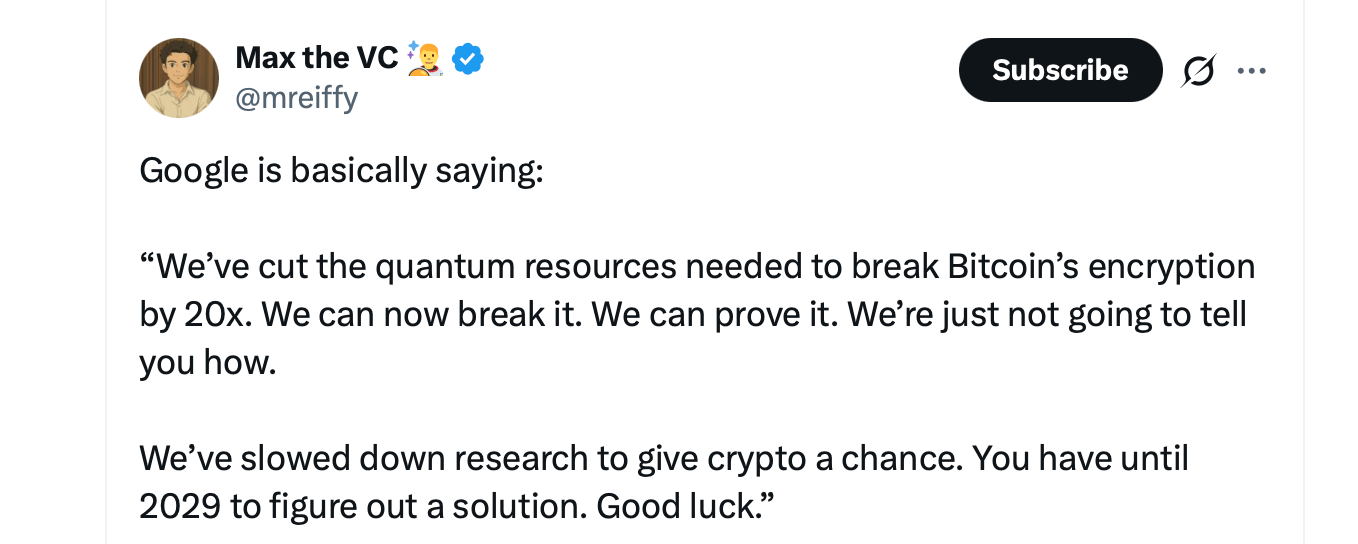
Researchers estimate that a sufficiently advanced quantum system could execute the attack using fewer than 500,000 physical qubits, a roughly 20-fold reduction from earlier projections that stretched into the millions. The improvement stems from circuit-level optimizations and more efficient error correction assumptions aligned with modern superconducting hardware models.
In practical terms, the Google paper outlines two paths: a low-qubit design using under 1,200 logical qubits and a low-gate version requiring about 1,450 logical qubits. Both dramatically compress the computational burden, shifting the conversation from theoretical to plausible within the next decade.
The most attention-grabbing scenario involves real-time transaction interception. Under ideal conditions, a “cryptographically relevant quantum computer” could derive a private key from a broadcast transaction in roughly nine minutes. Given Bitcoin’s average 10-minute block interval, the authors estimate a 41% chance of successfully hijacking a transaction before confirmation.
That is not a guaranteed break, but it is enough to make developers uncomfortable.
A second, quieter risk sits in long-term exposure. Wallets with publicly revealed keys, including reused addresses and older formats like pay-to-public-key, could be cracked without any timing constraints. The paper estimates roughly 6.9 million BTC, or about 32% of total supply, falls into this category.
Taproot, introduced to improve privacy and efficiency, adds a twist. While it streamlines transactions, certain spending paths expose public keys more directly, increasing susceptibility in an “at-rest” attack model. The report points to proposals like BIP-360 as potential mitigations.
Importantly, proof-of-work (PoW) remains intact. Quantum algorithms such as Grover’s only provide a quadratic speedup against hashing, which does not threaten Bitcoin’s security model in the same way.
Ethereum faces a broader attack surface. Externally owned accounts, validator keys, and cryptographic primitives like BLS signatures all come into play. The paper suggests tens of millions of ether sit in potentially vulnerable configurations, depending on future timelines.
That timeline is where things get interesting.
Google’s broader messaging ties the research to a 2029 target for migrating its own systems to post-quantum cryptography. The implication is clear: if a company operating at the frontier of quantum hardware is setting that deadline internally, it expects meaningful progress well before then.
Still, there is no quantum machine today capable of executing these attacks. Current systems remain noisy and far below the required scale. The gap between laboratory devices and fault-tolerant machines with hundreds of thousands of qubits is significant.
Crypto developers are responding along familiar lines: slow, methodical, and occasionally stubborn.
Ethereum has spent years preparing for quantum-resistant upgrades, with roadmap milestones already mapped out toward the end of the decade. Account abstraction and signature flexibility give it a head start in swapping cryptographic primitives.
Bitcoin’s path is more deliberate. Proposals like BIP-360 and experimental test networks are early steps, but full migration would likely require a major consensus upgrade. History suggests it can be done, but not quickly.
A Mix of Urgency and Skepticism
Outside core development circles, the market reaction has been notably calm. Social media discussions show a mix of technical analysis, skepticism, and long-term planning rather than panic selling. One specific view is that quantum risk is real, but not immediate. Others wholeheartidly disagree.
“Google has sounded the quantum alarm,” Project Eleven, a quantum computing research organization wrote on X. The organization has been pushing for quantum safeguards for quite some time.
Former Binance boss Changpeng Zhao, widely known as CZ, struck a calmer tone on X, brushing aside panic while acknowledging the friction ahead. “Saw some people panicking or asking about quantum computing’s impact on crypto. At a high level, all crypto has to do is to upgrade to Quantum-Resistant (Post-Quantum) Algorithms. So, no need to panic,” he said, before adding that execution will be anything but trivial in decentralized systems.
From the perspective of Ethereum researcher Justin Drake, the moment marks a clear inflection point rather than a distant concern. “Today is a monumentous day for quantum computing and cryptography,” he wrote, adding that “the results are shocking” as improvements to Shor’s algorithm stack across layers.
Drake disclosed that his confidence in a quantum event has risen, noting “there’s at least a 10% chance that by 2032 a quantum computer recovers a secp256k1 ECDSA private key,” and stressed that “now is undoubtedly the time to start preparing.”
In a note shared with Bitcoin.com News, analysts at Bitfinex framed the issue as a manageable engineering problem rather than a looming collapse. “Quantum computing represents a genuine engineering challenge for the cryptocurrency industry, but it is far from an existential threat in the current form,” they said, noting that cryptographic limits have long been understood.
The Bitfinex analysts further added that “the industry is already moving,” pointing to NIST’s 2024 standards and ongoing work like BIP-360, while stressing that “the path from theoretical vulnerability to practical exploitation is extraordinarily long.”
Many believe that the white paper is not a doomsday memo. It is a deliberate nudge to begin preparing before preparation becomes urgent. When timelines move from “someday” to “within a decade,” even the most patient systems have to start moving.
FAQ
- What did Google’s quantum research reveal about Bitcoin security?
It showed quantum attacks on Bitcoin’s encryption may require far fewer resources than previously estimated. - Can quantum computers break Bitcoin today?
No, current quantum systems are not advanced enough to execute these attacks in practice. - How much Bitcoin is potentially exposed to quantum risks?
Roughly 6.9 million BTC may be vulnerable due to exposed public keys. - What is the crypto industry doing to prepare?
Developers are exploring post-quantum cryptography and protocol upgrades to secure networks before quantum threats materialize.
Credit: Source link