

Close Menu
AsiaTokenFundAsiaTokenFund
  • Home
  • Crypto News
    • Bitcoin
    • Altcoin
  • Web3
    • Blockchain
  • Trading
  • Regulations
    • Scams
  • Submit Article
  • Contact Us
  • Terms of Use
    • Privacy Policy
    • DMCA
What's Hot

Electrum Wallet Attack Hid Bitcoin Theft Behind a Fee Increase

October 25, 2026

The Velvet Rope Is Coming Down: Why Singularity Rethinks Who Gets to Compound Wealth

October 25, 2026

Can ENA Reach $0.55 After Ethena’s OKX Launch?

October 25, 2026
Facebook X (Twitter) Instagram
Facebook X (Twitter) YouTube LinkedIn
AsiaTokenFundAsiaTokenFund
ATF Capital
  • Home
  • Crypto News
    • Bitcoin
    • Altcoin
  • Web3
    • Blockchain
  • Trading
  • Regulations
    • Scams
  • Submit Article
  • Contact Us
  • Terms of Use
    • Privacy Policy
    • DMCA
AsiaTokenFundAsiaTokenFund

1% crypto capital cap: Bank of Russia’s proposal

0
By Aggregated - see source on September 20, 2026 Regulations
Share
Facebook Twitter LinkedIn Pinterest Email

The Bank of Russia has proposed a 1% crypto capital cap, limiting covered crypto and foreign-digital-instrument risk to a bank’s own funds while leaving some client custody positions outside the new calculation.

The Sept. 18 proposal would create N31 for individual credit institutions and N32 for banking groups on a consolidated basis. Each ratio compares covered exposure with the relevant institution’s capital, not its total assets. The rules remain in draft form.

The two-level structure subjects both a bank and its wider group to the same proposed percentage ceiling. N31 uses the individual institution’s own funds, while N32 uses consolidated group capital, keeping the measurement tied to the entity that carries the covered risk.

Related Reading

Russia’s legal crypto on-ramp to arrive with a state-owned bank holding the keys

What the 1% crypto capital cap captures

The draft regulation reaches beyond coins held outright. Its numerator includes direct and indirect investments, derivatives tied to crypto prices, and instruments such as loans, bonds, guarantees, repos and credit lines when their settlement or value depends on crypto or foreign digital instruments.

Banks would receive limited recognition for hedges. Long and short positions may be netted only within the draft’s qualifying lower-risk category, which imposes conditions tied to the asset, settlement and maturity as well as freezing and liquidity risk. Direct holdings and other higher-risk exposures are measured more conservatively and cannot be fully neutralized by an offsetting position.

Related Reading

Banks get cross-exchange crypto hedge relief under Canada’s new 2027 capital rule

The treatment of customer assets turns on who bears the loss if assets are seized or transactions are restricted. A custody position enters N31 or N32 when the bank, or a digital depository in its group, is liable for that loss. If the bank does not bear that responsibility, the client position is excluded from the two 1% ratios.

The Catalyst

What’s moving crypto. Why it matters.

Get CryptoSlate’s essential stories and what to watch next.

Published on Substack

Seven days a week. Unsubscribe anytime.

Whoops, looks like there was a problem. Please try again.

Check your inbox.

Your signup request was sent. If confirmation is required, follow the email from Substack.

Look in spam or promotions if you don’t see it.

That exclusion does not remove the position from prudential treatment. For covered bank and group capital-adequacy calculations, the draft assigns non-liable client custody positions a 50% risk weight. Own-account exposure and client positions for which the bank is liable receive a 1,250% risk weight.
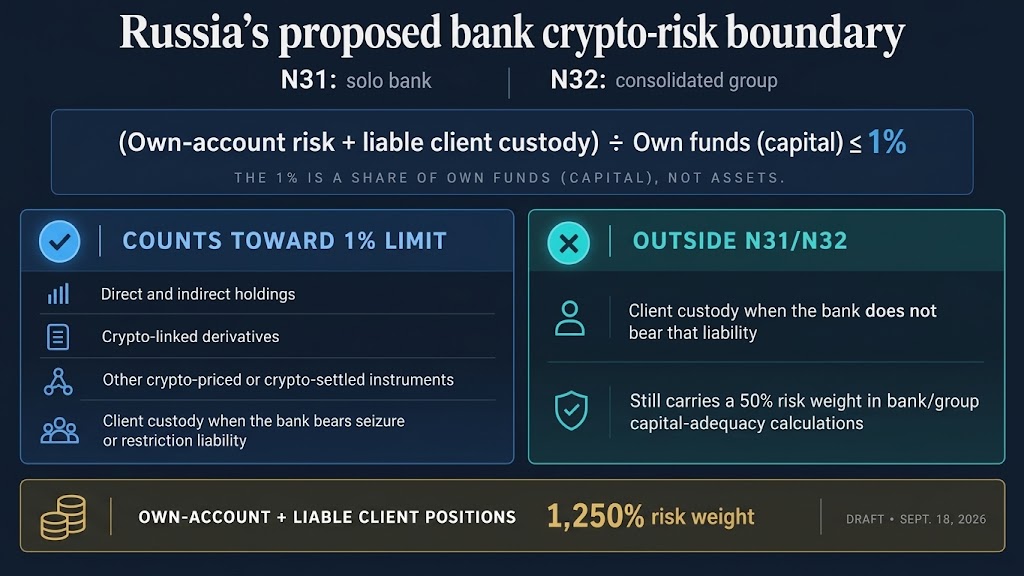
Diagram of Russia’s proposed N31 and N32 bank crypto-risk boundary, showing what counts toward the 1% capital limit and when client custody remains outside it.

Related Reading

Outdated bank rules may keep crypto outside the banks now allowed to hold it

The distinction permits custody without automatically treating every customer asset as the bank’s own exposure, provided the institution does not bear the specified seizure or restriction liability. It simultaneously places a tight capital-based constraint on direct holdings and other crypto-linked risk carried by the bank.

The ratios are part of Russia’s broader crypto-market rulemaking, a framework CryptoSlate has previously described as still being completed. The central bank plans official publication in the fourth quarter of 2026, with the requirements taking effect 10 days later. Banks are expected to begin reporting instrument turnover and N31/N32 values in January 2027, although detailed forms are still being developed.

Credit: Source link

Share. Facebook Twitter Pinterest LinkedIn Tumblr Email

Related Posts

Can ENA Reach $0.55 After Ethena’s OKX Launch?

October 25, 2026

Can INJ Reach $70 After Injective’s Washington Meetings?

October 24, 2026

US Tech Stocks Under Pressure: 3 Stocks to Watch Before Next Week’s Earnings

October 24, 2026
Leave A Reply Cancel Reply

What's New Here!

Electrum Wallet Attack Hid Bitcoin Theft Behind a Fee Increase

October 25, 2026

The Velvet Rope Is Coming Down: Why Singularity Rethinks Who Gets to Compound Wealth

October 25, 2026

Can ENA Reach $0.55 After Ethena’s OKX Launch?

October 25, 2026

Analyzing why Uniswap’s network growth hit a 4-year high despite UNI’s 5.4% drop

October 24, 2026
AsiaTokenFund
Facebook X (Twitter) LinkedIn YouTube
  • Home
  • Crypto News
    • Bitcoin
    • Altcoin
  • Web3
    • Blockchain
  • Trading
  • Regulations
    • Scams
  • Submit Article
  • Contact Us
  • Terms of Use
    • Privacy Policy
    • DMCA
© 2026 asiatokenfund.com - All Rights Reserved!

Type above and press Enter to search. Press Esc to cancel.

Ad Blocker Enabled!
Ad Blocker Enabled!
Our website is made possible by displaying online advertisements to our visitors. Please support us by disabling your Ad Blocker.