



Much of DeFi yield still depends on token incentives. When demand slows, those rewards tend to collapse. This has pushed users toward models built on real DeFi yield deriving from real economic activity where returns come from revenue rather than token issuance.
Ayni Gold uses such a model by linking on-chain rewards to physical gold mining output. The protocol distributes yield in PAXG, a gold-backed asset, thus providing non inflationary yield crypto tied to commodity production.
This review evaluates how Ayni Gold works, where it fits in the market, and how it differs from other real-yield DeFi protocols.
What is Ayni Gold?
Ayni Gold is a DeFi protocol that turns gold mining output into on-chain yield. Operating on gold extracted from the Minerales San Hilario concession in Peru, the protocol distributes quarterly rewards in PAXG, a gold-backed asset, to participants who stake AYNI tokens.
Each AYNI token represents a share of real mining capacity, not gold sitting in a vault. This makes Ayni Gold one of the few tokenized gold mining projects offering direct, on-chain exposure to production, not just to price.
Ayni Gold works by tokenizing the production capacity of a real gold mine, then distributing the revenue that the mine generates to people who stake the AYNI token. The flow has four steps, and each one is designed to connect a physical process to an on-chain record.
-
Gold is extracted from the Minerales San Hilario concession in Peru. This is a licensed mining operation, not a synthetic exposure or a paper contract.
-
The mine’s production capacity is tokenized. One AYNI token represents 4 cm³/hour of mining capacity, meaning each token corresponds to a specific share of the mine’s hourly processing ability.
-
Holders stake their AYNI tokens in the protocol. Staking is how the token connects to rewards, since an unstaked holder owns a claim on capacity but does not receive distributions.
-
The protocol converts part of the mine’s output into PAXG and distributes it quarterly to stakers. PAXG is a gold-backed token issued by Paxos, where each unit equals one troy ounce of physical gold in vaults, and stakers receive it in proportion to their capacity share.
What Makes Ayni Gold Different
What makes Ayni Gold different from other gold-backed tokens is that each AYNI represents a claim on gold mining output, not a claim on gold sitting in a vault. This changes how the token behaves economically.
To see why, it helps to look at how other gold-backed tokens are structured. Products like PAXG and XAUT hold physical gold in a custodian’s vault and issue tokens that represent ownership of that stored metal.
These tokens track the gold price, but the gold itself generates no income. The asset simply sits there, rising or falling with the market.
Ayni Gold operates on a different principle. The AYNI token represents productive capacity, the active, ongoing ability to extract and process gold at a working mine.
This puts AYNI closer in behavior to a mining royalty stream than to a gold ETF. Stakers are exposed to what the mine produces, not only to what a bar of gold is worth on a given day.
The result is a structurally richer form of gold exposure. Value comes from real operational output, not from a price chart alone.
|
Typical Gold-Backed Crypto
|
Ayni Gold
|
|
|
Yield source
|
Token emissions or transaction fees
|
Gold mining output
|
|
Reward asset
|
Native token or platform token
|
PAXG (gold-backed)
|
|
Sustainability
|
Depends on token demand
|
Tied to physical production
|
|
Risk type
|
Protocol and token risk
|
Operational and commodity risk
|
The Mining Operation Behind Ayni Gold
The gold behind Ayni Gold comes from Minerales San Hilario, a licensed mining operation in Peru. It is a 8 km² alluvial site registered with Peru’s Geological, Mining and Metallurgical Institute. This is the physical foundation the protocol’s tokens trace back to.
Projected daily production capacity at Minerales San Hilario is up to 8,000 grams, though actual output will depend on how operations ramp up over time.
A 2025 scoping study outlined 9+ metric tonnes of conceptual recoverable gold potential at the site. For context, a scoping study is an early-stage technical assessment that identifies potential, not a confirmed reserve estimate.
This is why the figure is framed as recoverable potential and not as proven reserves. Later-stage work, such as pre-feasibility and feasibility studies, would be needed to confirm the full economics.
Trust, Audits, and Transparency
Ayni Gold has completed smart contract audits with two of the most recognised firms in crypto security. The CertiK audit was finalised in October 2025, and PeckShield conducted a separate audit.
The legal structure behind the project is also public. Minerales SH San Hilario S.C.R.L. is the Peruvian mining company that operates the concession and is registered under local mining law.
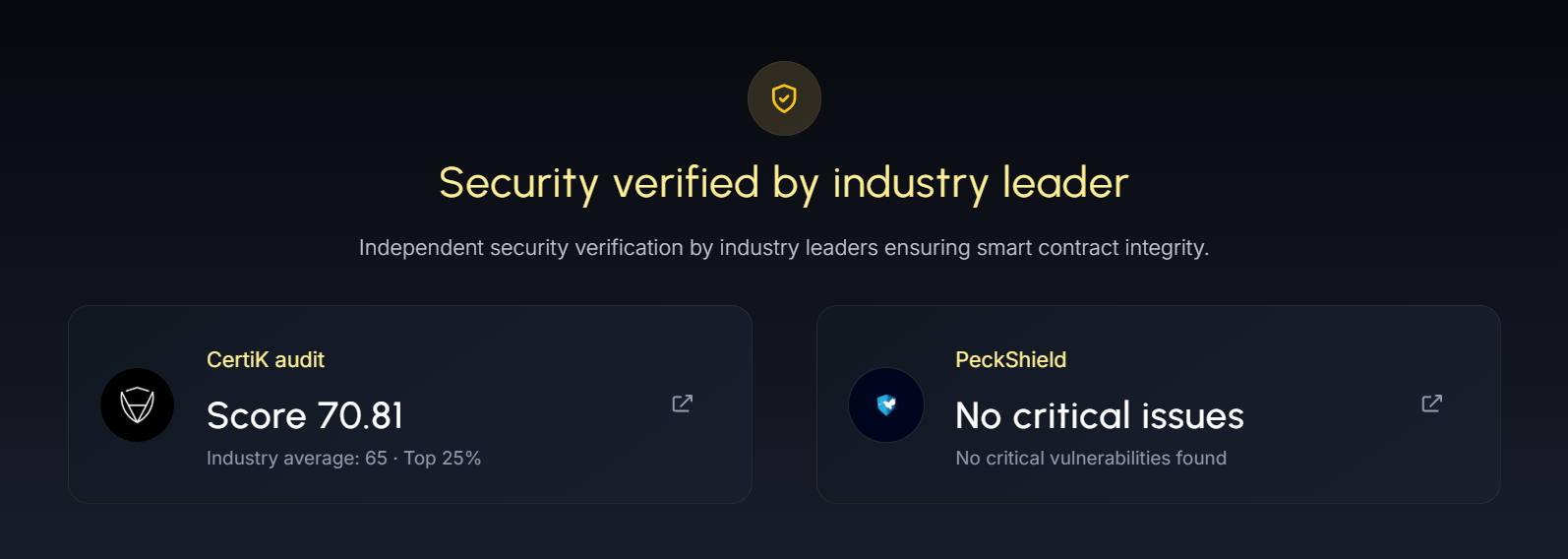
The split structure, with the mining operation and the token issuer as distinct legal entities, is a standard setup for tokenized commodity projects. It keeps operational responsibilities clearly divided.
Transparency also runs through the protocol itself. Ayni Gold is designed to anchor production records on the blockchain, so each reported output ties back to an immutable record anyone can verify.
Proof-of-reserve mechanisms like this have become a baseline expectation in gold-backed crypto, mirroring the approach used by Ondo Finance in the tokenized US Treasury category.
The structural idea is the same across both. A real-world asset produces value, and the on-chain record is what allows that value to be verified without a single point of trust.
Where Ayni Gold Fits in the Current DeFi Market
Ayni Gold is part of the gold-backed crypto category, alongside tokens like PAXG and XAUT. What sets it apart is how it generates yield: from active gold mining, not from gold stored in a vault.
Ayni Gold fits across three specific areas of the market:
-
Gold-backed crypto with a yield dimension. Most tokens in this category, like PAXG and XAUT, track the gold price without generating income. Ayni Gold adds quarterly PAXG rewards funded by real mining output.
-
Real-yield DeFi. Real yield means returns paid out of genuine revenue a protocol generates, not yield funded by printing more of its own token. Ayni Gold’s rewards come from gold production, which makes it a sustainable DeFi yield model tied to real economic activity.
-
On-chain access to a physical asset class. Gold mining has historically been accessed through equities or ETFs. Ayni Gold offers exposure to mining output on-chain, in a tokenized form.
Emission-based yield depends on rising token demand. When demand drops, so does the yield. Ayni Gold works differently. Its rewards depend on two things: how much gold the mine produces and the market price of that gold. The AYNI token price has no impact on either.
PAXG and Ayni Gold both offer gold exposure on the blockchain, but they do it in different ways. PAXG is a savings account in gold. Ayni Gold is a share in gold being produced.
Who Ayni Gold Is Built For
The first is people who want gold exposure that also generates income, not just price exposure. Traditional gold holdings, whether bullion or ETFs, do not produce cash flow on their own. Ayni Gold is structured to give both. It offers exposure to the commodity and periodic rewards in a gold-backed asset.
The second profile is DeFi users who have moved away from emission-driven yield and want returns tied to real, verifiable revenue. For this group, the sustainability of the yield source matters more than a headline APY.
The third profile is users who prefer commodity-denominated rewards. Because Ayni Gold pays in PAXG, not in its own project token, the value of each distribution tracks gold. Gold carries its own long-term market history, separate from the project’s token price.
Final Take
Ayni Gold introduces a production-based yield model that differs from most DeFi protocols. Instead of relying on token incentives, it links rewards to physical gold extraction and distributes them in a gold-backed asset.
The AYNI token is the mechanism that connects a staker to a share of the mine’s capacity. It is not a claim on stored metal.
For users reallocating toward real yield DeFi strategies, Ayni Gold provides exposure to a less explored segment: on-chain access to commodity production.
FAQ
What is Ayni Gold in simple terms?
Ayni Gold is a DeFi protocol that links blockchain to a real gold mine in Peru. Users who stake AYNI tokens receive quarterly rewards in PAXG, a gold-backed digital asset. Each AYNI represents a share of the mine’s production capacity, so rewards come from actual gold output, not token emissions.
How does Ayni Gold generate yield?
Ayni Gold generates yield from physical gold mining at the Minerales San Hilario concession in Peru. Gold extracted from the site is converted into revenue, and part of that revenue is distributed quarterly to stakers in PAXG. The yield comes from real production, not from protocol token emissions.
What backs the AYNI token?
Each AYNI token represents a claim on gold mining capacity at the Minerales San Hilario concession in Peru. One AYNI corresponds to 4 cm³/hour of processing capacity at the mine. It is not a claim on stored gold. It is a claim on the mine’s ability to produce gold.
Has Ayni Gold been audited?
Yes. Ayni Gold has completed smart contract audits with two recognised security firms. CertiK completed its audit in October 2025, and PeckShield conducted a separate audit. Both reports are publicly available on the Ayni Gold website, which allows any user to review the findings directly.
How is Ayni Gold different from PAXG?
PAXG and Ayni Gold both give exposure to gold on the blockchain, but they serve different purposes. PAXG represents one troy ounce of stored gold and tracks the gold price. Ayni represents a share of gold mining capacity and distributes quarterly rewards in PAXG. One is static ownership, the other is productive.
Disclaimer: This article is provided for informational purposes only. It is not offered or intended to be used as legal, tax, investment, financial, or other advice.
Credit: Source link