



Bitcoin’s recovery above $85,000 faces a demand test after a sharp fall in bets on another Federal Reserve rate hike. A new post-payroll study places the strongest burst of forced buying before Friday’s jobs report, while Bitcoin retreated after the release.
Bitcoin was $85,276 around press time, up 0.83% over 24 hours. The Sunday price remained below the $86,000 area reached before payrolls.
For holders tracking Bitcoin’s recovery, the gap raises a practical question: who will sustain the recovery after the initial short squeeze? Thursday’s ETF inflows provided a buying signal, but incomplete Friday figures leave the industry’s response to payrolls unresolved heading into Monday’s US session.
The squeeze came before payrolls
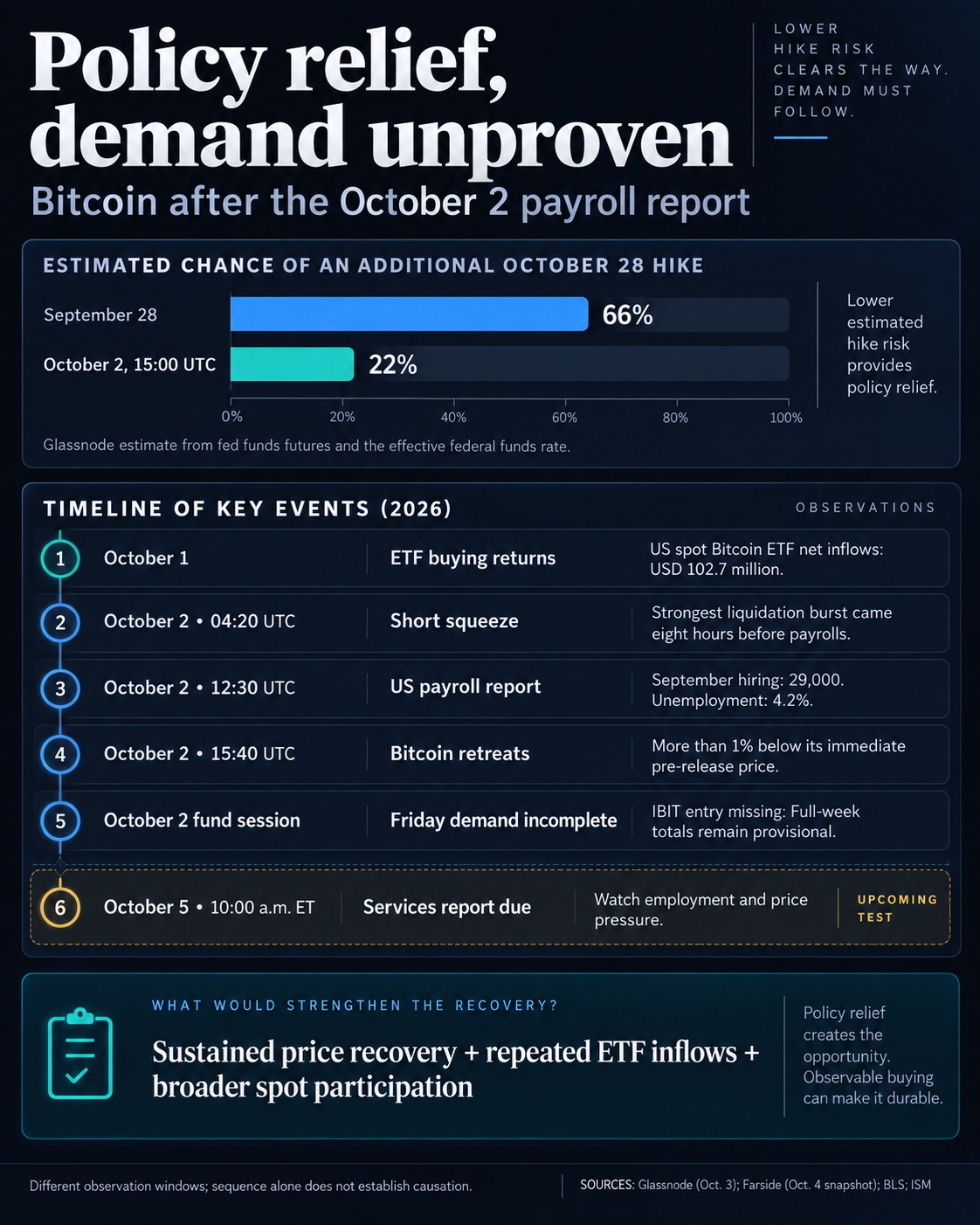
Glassnode’s Oct. 3 post-payroll study estimated the probability of an additional quarter-point hike at the Oct. 28 meeting fell from 66% on Sept. 28 to 22% by 15:00 UTC on Oct. 2. The estimate comes from Glassnode’s calculations using fed funds futures and the effective federal funds rate.
The timing of the strongest forced buying is revealing. Glassnode measured $50 million of short liquidations in ten minutes at 04:20 UTC on Oct. 2, eight hours before the jobs release. By 15:40 UTC, Bitcoin was more than 1% below its immediate pre-release level.
Short sellers can add buying pressure when rising prices force them to close their positions. Once those positions are closed, maintaining the higher price requires other buyers to absorb continuing offers. Friday’s sequence supports caution about extrapolating the overnight advance into lasting investor commitment.
Open interest, the value of outstanding futures positions, rose $2.1 billion in the 24 hours before payrolls, according to Glassnode. Positions also grew about 2.5% when measured in coins. Open interest then fell $1.5 billion after continuing to rise for roughly an hour following the release.
The dollar change tracks outstanding exposure and is affected by valuation; investment capital lost is a different measure. The study’s sequence links expanding positions to the advance and their subsequent retreat to falling prices, while leaving the cause of the reversal unresolved.
The fund market supplies a separate piece of evidence. US spot Bitcoin ETFs recorded net inflows of $102 million on Oct. 1, according to Farside Investors’ flow table.
That positive session followed Wednesday’s redemptions, showing that fund buying had returned before payrolls. It gives the recovery more substance than a short-covering explanation alone. Thursday’s flow, however, describes a session before the report, leaving Friday’s response to be measured separately.
Repeated inflows would extend Thursday’s evidence across more sessions and show whether investors keep committing money after the release. Renewed redemptions would instead put that positive day in the context of a recovery struggling for sustained fund support.
Participation also matters beyond fund subscriptions. In its Sept. 30 market study, Glassnode put combined spot-exchange and US spot-ETF trading volume at about $6.4 billion a day, near the bottom of its range since the ETFs launched. That pre-payroll assessment provides a dated baseline for judging whether activity broadens.
Trading volume measures transactions, including repeated trades. A rise would indicate greater activity, while fund flows provide a separate measure of subscriptions and redemptions. Read together with price, these observations can help distinguish broader participation from an advance dominated by the closing of futures positions.
Monday tests the path from policy relief to buying
The latest observed Fed decision was a rate increase. Its Sept. 16 announcement raised the target range by a quarter percentage point to 3.75%-4%. Falling October hike odds leave that increase in place; a cut would require a separate policy decision.
The September employment report, released on Oct. 2, recorded 29,000 payroll gains and 4.2% unemployment. The Bureau of Labor Statistics described both as little changed. Slower hiring can give policymakers reason for patience, making the report relevant to the next decision even while September’s increase remains the policy baseline.
Longer-term rates present another hurdle. Glassnode’s Friday intraday study showed short-term yields falling while long-term yields rose, with the ten-year near 5.2%. That divergence matters because a reduced prospect of further Fed hikes can coexist with elevated longer-term borrowing costs.
For Bitcoin, the benefit depends on how investors respond. A more favorable outlook for the next policy meeting may encourage additional exposure. Whether that becomes sustained buying must be observed in the market, alongside the financing conditions investors still face.
The Institute for Supply Management’s September services report is scheduled for Monday, Oct. 5 at 10:00 a.m. ET. Its previous August survey combined a headline PMI of 55.4 with employment at 47.8 and a prices index of 72.6: expanding activity, contracting employment and broad input-cost pressure.
That combination makes the next report’s details relevant alongside its headline. Softer employment accompanied by easing price pressure could reinforce the argument for policy patience. Persistent price pressure or stronger activity could complicate it. The services release therefore supplies a fresh check on the rate outlook that emerged from payrolls.
The next US ETF sessions will show whether fund investors keep buying as the market absorbs that outlook. Their timing matters: flows reported after the release can extend the evidence beyond the Thursday inflow already recorded, while a completed Friday row would clarify the initial response.
Bitcoin stood above $85,000 in Sunday’s snapshot but below its pre-payroll $86,000 area. Sustaining a recovery toward that level with repeated fund inflows and stronger spot participation would weaken the demand concern. Another rejection without those supporting signals would strengthen it. Those combined observations would give holders firmer evidence of follow-through than a lower hike-probability estimate alone.
Credit: Source link