



Kraken will replace 176 cryptocurrency trading pairs with synthetic markets, eliminating maker-fee eligibility and forcing the cancellation of outstanding orders.
The exchange said in an Oct. 27 notice that affected markets will enter cancel-only mode on Nov. 6 at 14:00 UTC, preventing customers from submitting new orders. Existing orders will be canceled and the native markets removed between Nov. 6 and Nov. 9.
Replacement markets are scheduled to become available by the end of Nov. 9, although customers must submit fresh orders because existing instructions will not transfer.
The changes affect pairs including BTC/DAI, ETH/JPY, AAVE/BTC, ADA/AUD and SHIB/USDT. Kraken said the underlying cryptocurrencies will remain available on its platform, while customer balances and margin trading pairs will be unaffected.
Kraken’s synthetic markets eliminate maker pricing
The migration changes how customers execute trades across the affected markets, replacing traditional order books with a system that routes transactions through existing liquidity pools.
Under Kraken’s synthetic trading model, orders execute through two underlying markets that share a common currency, typically the US dollar, with both transactions completed simultaneously in its matching engine.
A customer exchanging Solana for Dogecoin, for example, can have the transaction routed through SOL/USD and DOGE/USD. Kraken combines the execution into a single trade and applies one consolidated fee.
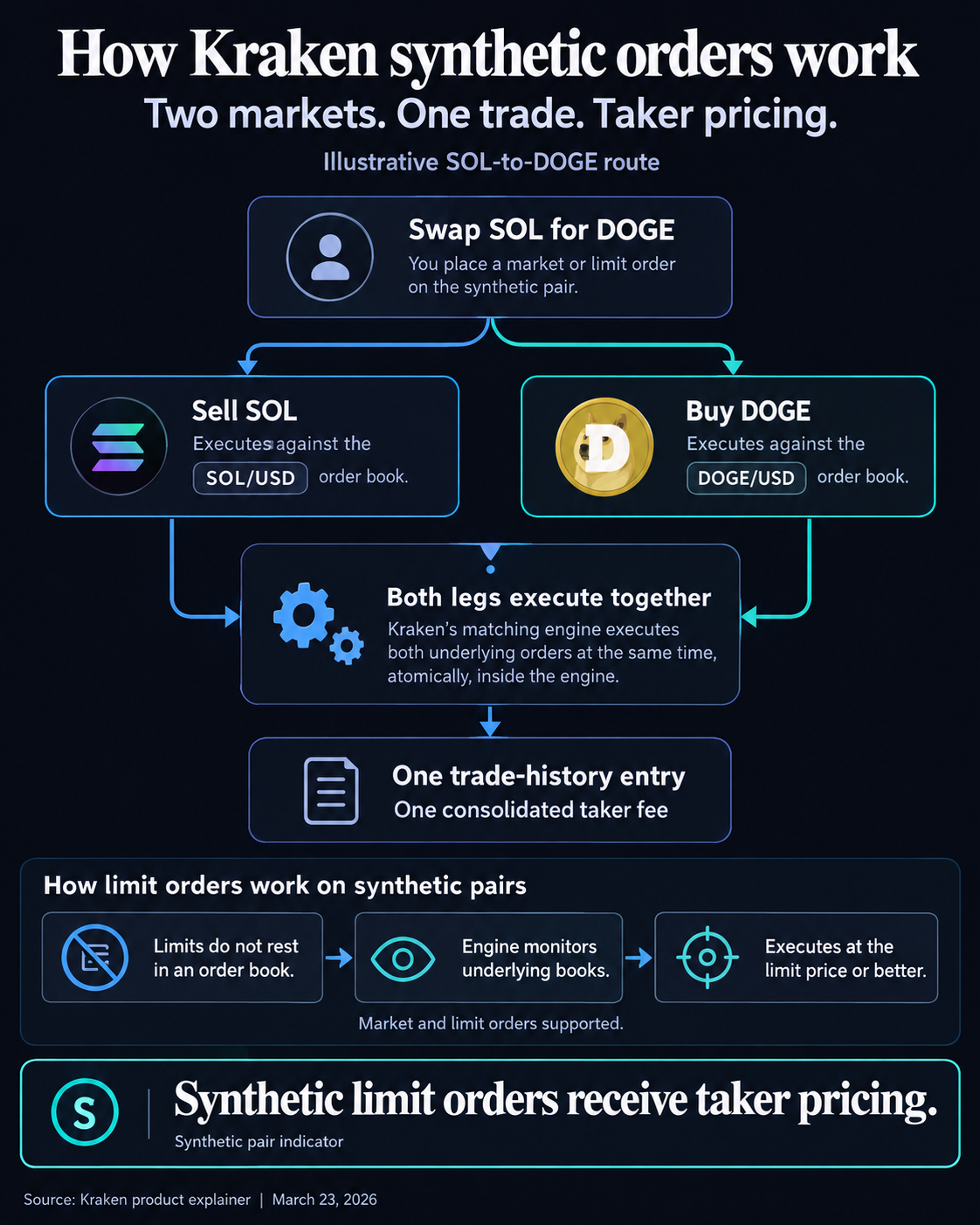
The arrangement eliminates the need for dedicated order books for each trading pair, allowing customers to exchange assets using liquidity available across existing markets.
However, the replacement changes the economics of limit orders, particularly for active traders and market makers who provide liquidity to exchanges.
On traditional order books, customers can qualify for maker pricing when their orders remain available for other traders to execute against. Kraken’s synthetic markets instead charge taker fees on every transaction, including limit orders.
Synthetic limit orders will remain available, but they will execute only when the underlying markets offer sufficient liquidity at the customer’s specified price or better.
The new markets also eliminate partial fills and several advanced trading instructions, including post-only orders and time-in-force settings.
Those restrictions affect trading strategies that depend on providing liquidity, managing partially executed positions or maintaining orders at specific points in the order book.
Kraken said its synthetic model could offer tighter spreads than native markets with limited liquidity because execution draws from deeper underlying order books. Customers also pay one taker fee rather than the separate fees associated with completing two trades manually.
The exchange already offers more than 10,000 synthetic pairs through Kraken Pro, covering combinations of cryptocurrencies, stablecoins and fiat currencies. The affected markets will join that existing system rather than operate through independent order books.
Credit: Source link