

President Donald Trump’s 2025 annual financial disclosure was filed with the Office of Government Ethics on June 29 and certified on June 30, arriving as the CLARITY Act stalls over whether elected officials and their families should be allowed to hold, issue, promote, or profit from digital assets while writing the rules for those markets.
Trump received a 45-day extension and paid late-filing fees for transactions not previously reported on interim 278-T forms.
The agency ethics official still concluded, based on the report, that the filer complied with applicable laws and regulations. That line is available to anyone who wants to argue that the disclosure system worked exactly as intended.
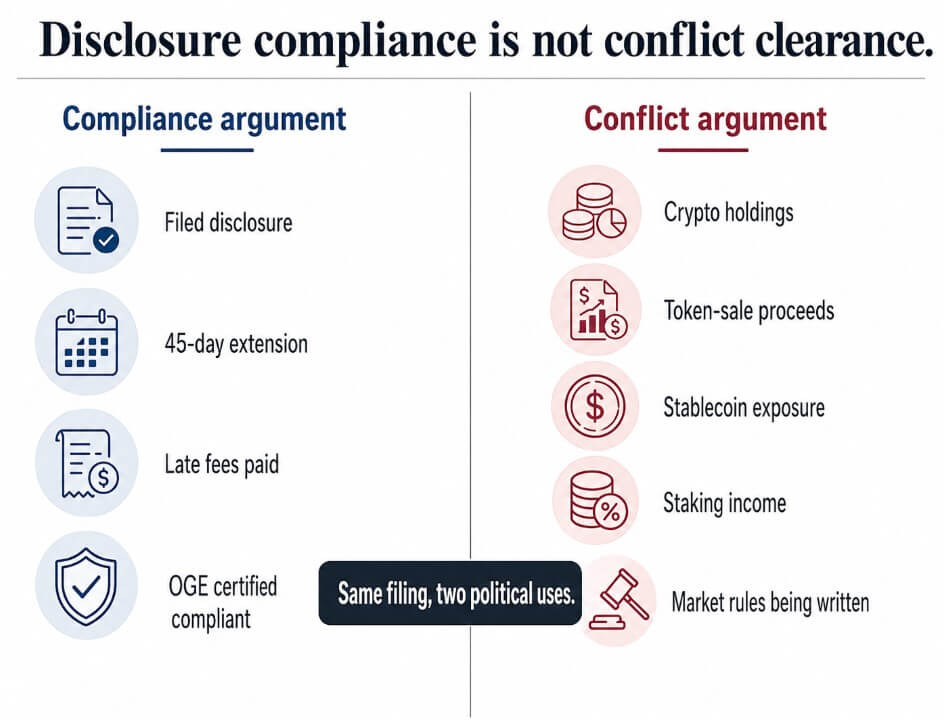
Opponents now have a target on the filing documents, which show that the president holds exposure across the same market categories that Congress is trying to classify, supervise, and regulate through CLARITY, including memecoins, NFTs, Bitcoin, Ethereum, staking, stablecoins, DeFi tokens, governance tokens, and World Liberty Financial-linked token-sale proceeds.
Disclosure compliance and conflict clearance are separate standards, and a president can file on time, pay late fees, and still hold massive financial interests in the markets his administration is shaping through legislation, executive appointments, and regulatory posture.
How deep the exposure runs
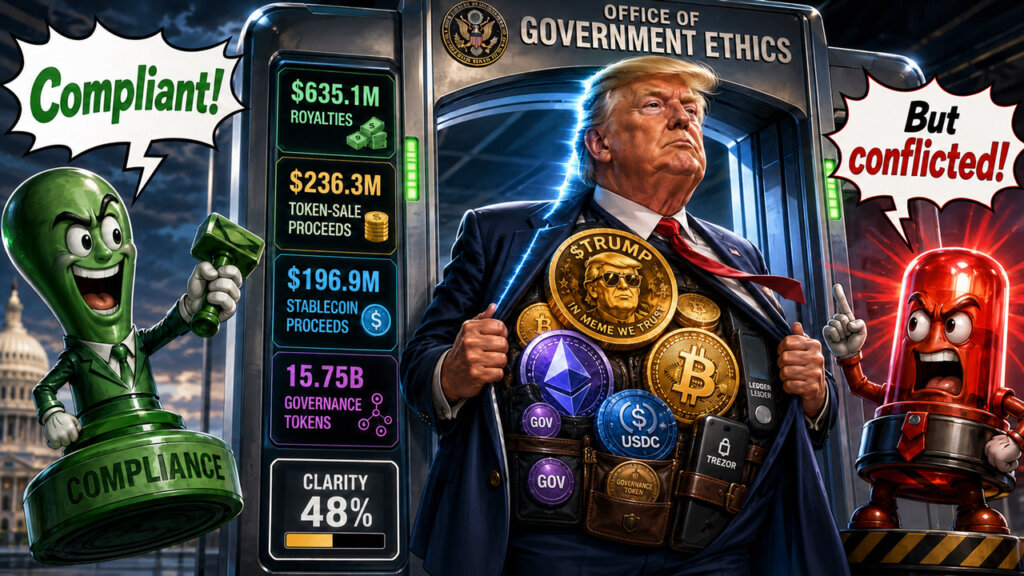
CIC Digital LLC, which licenses fees for NFTs and memecoins, discloses a Bitcoin cold wallet valued at over $50 million, an Ethereum cold wallet valued at $5 million to $25 million, a USDC cold wallet valued at $5 million to $25 million, and Ethereum staking rewards through Coinbase of $510,808.
Its largest line item is a license agreement with Celebration Coins that generated $635,068,835 in royalties, the TRUMP memecoin’s economic link to the filing.
DT Marks DeFi LLC, which holds a 38.25% interest in WLF Holdco LLC, discloses $65,625,000 from an equity sale and $236,250,000 from token-sale proceeds distributed by World Liberty Financial.
The token-sale distribution wallets disclose ETH and BTC valued at over $50 million, as well as additional WLF-distributed proceeds across LINK, AAVE, ENA, MOVE, and ONDO wallets.
Ethereum staking validator rewards under this section total $1,821,628, while DTTM Operations LLC holds 15,750,000,000 governance tokens of World Liberty Financial, valued at over $50 million.
The stablecoin layer appears through DT Marks SC LLC, which reports $196,875,000 in net proceeds from an equity sale in Stablecoin Holdco LLC.
The Stablecoin Holdco entity itself is valued at $5 million to $25 million and describes its underlying asset as a stablecoin business that generated $8,326,828 in net operating income. On the spouse disclosure, a license agreement for NFTs and collectibles generated $6,011,259 in net proceeds.
The filing spans every regulatory category CLARITY would govern: digital commodities, consumer protection, stablecoin oversight, DeFi token classification, and governance disclosure. An abstract ethics debate just became a balance sheet.
| CLARITY-relevant category | Filing exposure | Reported value / income | Why it matters |
|---|---|---|---|
| Memecoins / NFTs | CIC Digital licensing, Celebration Coins royalties, spouse NFT license | $635.1M royalties; $6.0M spouse NFT proceeds | Connects consumer-protection and token-promotion debates to disclosed income |
| Bitcoin / Ethereum | BTC and ETH cold wallets across CIC Digital and WLF-linked rows | Multiple wallets, including over $50M BTC/ETH rows | Touches digital commodity classification and market oversight |
| Staking | Coinbase ETH staking and validator rewards | $510,808; $1.82M | Connects to yield, custody, and intermediary rules |
| Stablecoins | USDC wallet, Stablecoin Holdco, stablecoin business income | $196.9M proceeds; $8.3M operating income | Puts the filing inside stablecoin oversight debates |
| DeFi tokens | LINK, AAVE, ENA, MOVE, ONDO wallets | Various wallet values and token-sale distributions | Maps to token classification and DeFi-market rules |
| Governance tokens | World Liberty Financial governance tokens | 15.75B tokens, valued over $50M | Raises control, governance, and disclosure questions |
| Token sales | WLF token-sale proceeds | $236.3M | Directly links the filing to issuance and sale rules |
What it means for the vote
The CLARITY Act cleared the Senate Banking Committee 15-9 on May 14, with all Republicans and two Democrats voting in favor.
Ruben Gallego of Arizona and Angela Alsobrooks of Maryland said their committee votes did not guarantee floor support without progress on outstanding issues, specifically an ethics provision addressing government officials’ ties to the crypto industry.
On the Senate floor, the bill needs 60 votes, meaning at least seven Democrats must cross over, and a Senate Banking Committee amendment from Sen. Chris Van Hollen that would have barred the president, vice president, and members of Congress from participating in crypto businesses failed on a straight 13-11 party-line vote at the markup.
The Senate returns from recess on July 13 and breaks again in August, and most observers treat the August recess as the last realistic gate for passage in 2026.
Polymarket traders put the 2026 signing at 48%, down from 74% in May, while Galaxy Research head Alex Thorn cut his own estimate to 50% from 60% on June 26, citing a tightening Senate calendar and stalled negotiations as the primary drivers.
Senator Cynthia Lummis has warned that missing this window risks pushing legislation to 2030 or beyond, given how a new chamber composition from the November midterms could realign the math.
In the favorable path, CLARITY’s supporters point to the OGE certification as proof that the existing disclosure system works. Ethics language gets narrowed, handled in a parallel agreement, or delayed to a subsequent bill.
The Senate’s Republican caucus and the two Democratic votes already in place hold, Majority Leader John Thune schedules floor time before the August recess, and a third-party ethics framework negotiated separately gives the remaining Democrats enough cover to vote yes.
That would deliver a federal framework for digital commodities, CFTC oversight of crypto markets, and clearer rules for DeFi and stablecoins before the election cycle begins.
In the less favorable path, the filing becomes the Democrats’ most powerful exhibit, with the breadth of the president’s exposure spanning $635 million in memecoin royalties, $236 million in WLF token-sale proceeds, $196 million in stablecoin-related proceeds, 15.75 billion governance tokens, and DeFi wallets across AAVE, LINK, ENA, MOVE, and ONDO.
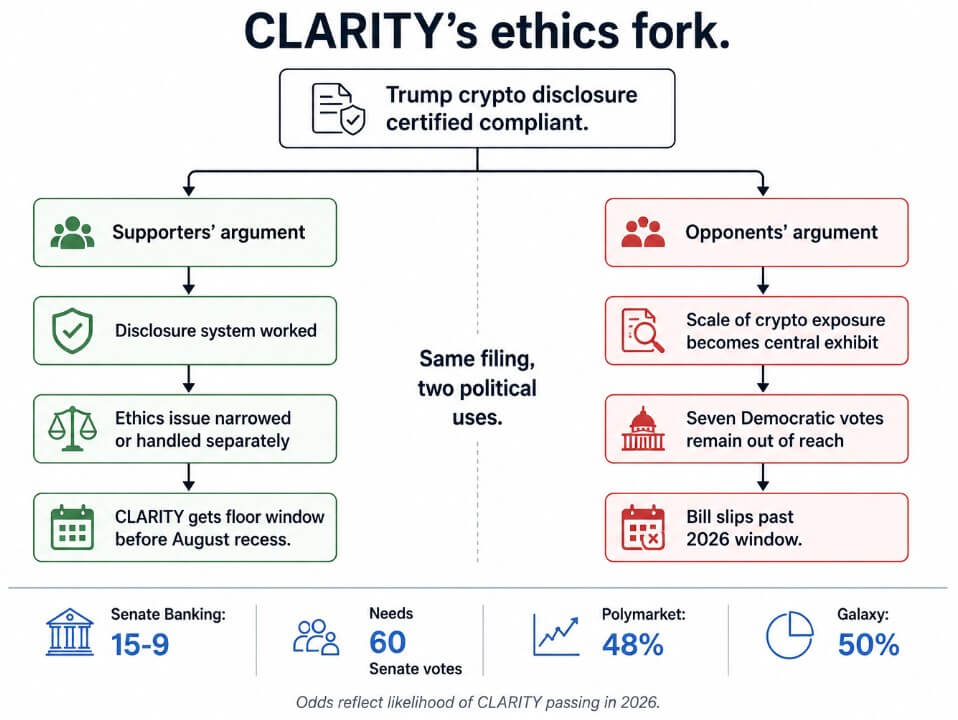
The ethics objection becomes harder to isolate from the market-structure debate, the seven Democratic votes stay out of reach before August, and CLARITY gets pushed to a post-election Congress where the bill restarts with a different chamber and a different legislative calendar.
The filing may give Trump’s allies the argument that he has nothing to hide. By documenting exactly how much he holds across every category Congress is actively defining, it also makes the ethics fight harder to separate from the market-structure fight.
Supporters can say the disclosure system functioned as designed, and opponents can say the scale of what was disclosed is precisely the problem.
Credit: Source link