


Comcast just pulled the pin on a classic event trade: break the company in two, let the pieces find cleaner multiples, and see if shareholders finally get paid for assets that were swimming in a conglomerate discount.
If you’re wondering whether the NBCUniversal spin-off can actually unlock value for CMCSA holders, this walkthrough cuts through the noise. We’ll map the mechanics, what the market is likely to price, where it can go wrong, and how event-driven investors typically navigate these breakups.
Timing matters here. The playbook changes around key dates, when-issued trading, and index reshuffles. Get the sequence right and you avoid most of the traps.
Editor’s note: In Q1–Q2 2026 I watched event-driven desks get busy again as spins and breakups came back into fashion. The common thread wasn’t story, it was structure: who takes the debt, who gets the buyback, and how clean the when-issued trading looks. We saw a few telecom-media names trade like factor bets around index dates, which bled into crypto volumes on rebalancing weeks. My takeaway is simple: the pop on announcement is rarely the trade. The trade is in the docs, the capital policy, and the first clean guide post-close. — Darnell Whitaker
Yes, Comcast can unlock value with the NBCUniversal spin-off, but it hinges on execution details: how debt and cash end up split, whether the media business shows a credible earnings path, and what the remaining connectivity stub does with buybacks and dividends. The structure is tax-free, management has been named, and the market’s initial read was positive — now it’s about follow-through.
- Comcast plans a tax-free spin of NBCUniversal, including Sky, within roughly a year Comcast press release (pdf).
- CMCSA said it may retain up to 19.9% of NBCU for up to one year post-spin, to monetize later tax-efficiently Comcast press release (pdf).
- Leadership is set: Mike Cavanagh to lead NBCU; Michael Angelakis to run the remaining connectivity company Comcast press release (pdf).
- Shares spiked in premarket by about 21.75% on the news before moderating intraday, signaling a sum-of-the-parts re-rating impulse Financial Express.
- Biggest swing factors: debt allocation, buyback pace at the connectivity stub, streaming trajectory, and park cycle for NBCU.
What exactly is being spun off, and why now?
Comcast announced it will separate into two public companies through a tax-free distribution of NBCUniversal, which includes Sky, targeting completion in about a year Comcast press release (pdf). The remaining company focuses on connectivity: think broadband, wireless, and enterprise services. The spin isolates the media engine — film, TV networks, Peacock, theme parks, and Sky — away from the capital-heavy and steadier connectivity cash machine.
The company also said it expects to keep up to 19.9% of NBCU for up to a year after the spin and then monetize that stake in a tax-efficient way Comcast press release (pdf). That retained slice often serves as a transition buffer and a financing or strategic lever. It can be an overhang if not handled cleanly, but it also gives flexibility.
Leadership is locked: Mike Cavanagh is set to become CEO of the spun NBCU, and former CFO Michael Angelakis will lead the remaining connectivity business Comcast press release (pdf). The market liked the clarity. In premarket the stock jumped over 21% before cooling once regular hours began, a textbook reaction to a promised sum-of-the-parts unlock Financial Express.
Why now? Because investors have been pressuring mixed media-telecom conglomerates to simplify. The last few years punished complexity and rewarded focus. This move shoves Comcast into two cleaner stories that funds can model and own without justifying cross-subsidies.
How could a tax-free spin boost valuation for both stocks?
Spins work when the market stops assigning a blended multiple and starts paying each business the rate the nearest peers get. Connectivity often trades like a bond proxy with stable cash flows, buybacks, and dividends. Media and theme parks are cyclical, IP-driven, and can carry wider outcome ranges. Splitting them lets each hunt its natural shareholder base.
Tax-free matters because it avoids a big one-time tax bill that would sap equity value. It also makes the distribution more palatable for long-only funds. A clean structure tees up standard playbooks: media gets a path to profitability and IP monetization; connectivity leans into capital returns and disciplined capex.
But value doesn’t just appear because you file a Form 10. You need a few things to line up: a balanced debt split that doesn’t strangle either entity, credible synergy separation plans, and forward guidance that helps the street renovate models without guesswork. The first few quarters set the tone.
One extra tailwind: governance clarity. Separate boards, separate comp plans, focused KPIs. Investors tend to pay more for alignment they can measure.
What will each company look like after the split?
The labels are straightforward: NBCUniversal becomes a pure media and entertainment platform, with Sky included. Comcast’s remaining entity leans into connectivity. You don’t need precise margin prints to understand how the market will probably frame them.
| Topic | NBCUniversal (spun) | Comcast (remaining) |
|---|---|---|
| Core focus | Film, TV networks, Peacock streaming, theme parks, Sky media | Broadband connectivity, wireless MVNO, enterprise services |
| Revenue drivers | Box office, licensing, ads, subs, park attendance, sports rights | Subscriber ARPU, net adds, small-business and enterprise demand |
| Capital profile | Content spend, park investments, sports rights commitments | Network upgrades, CPE, spectrum/MVNO costs, fiber builds |
| Investor base | Growth and cyclical media funds, special sits | Quality, income, infra-tilted, buyback-focused funds |
| Narrative | IP monetization, Peacock path, park cycle, Sky strategy | Stable FCF, capital returns, churn management, pricing power |
A small but important detail is the retained stake. Comcast plans to keep up to 19.9% of NBCU for up to a year after the spin and monetize it later Comcast press release (pdf). That overhang can cap NBCU’s stock in the near term if investors expect block sales. On the flip side, it can reduce supply shocks if management staggers exits.
Watch for capital return policies. Connectivity is the natural buyback engine if leverage is kept reasonable. NBCU has to balance content, parks, and rights spend with a dividend that doesn’t box it in. The first capital allocation frameworks after the spin will tell you who’s serious.
How do trading mechanics around the spin affect returns?
Event trades thrive on process. Most spins follow a familiar rhythm: board approval and Form 10, record date, distribution, then when-issued trading and index adjustments. You don’t need the exact calendar yet to plan your approach, but you should know what tends to matter.
- Record date mechanics: Hold CMCSA by the record date to receive NBCU shares. Brokers vary on settlement nuances. Confirm the ops details.
- When-issued trading: The spun stock and the parent sometimes trade when-issued for a few sessions before the official distribution. Prices can be jumpy with thin liquidity.
- Index flows: One entity may drop out of certain benchmarks temporarily, creating mechanical selling. Passive flows can exaggerate early moves.
- Options treatment: Listed options on CMCSA are usually adjusted at distribution. Strike and deliverables change. Read the OCC notice if you trade options.
Pro tip: The first week after distribution is often noisy. If you want the media asset, you can sometimes get better entry points after forced selling from funds that cannot hold the spun profile. The reverse can also be true for the stub.
On taxes, the company described the spin as tax-free to shareholders for U.S. federal income tax purposes Comcast press release (pdf). Even so, basis allocation between the two stocks will matter for eventual gains. The IRS typically publishes an allocation formula after the fact, and brokers often reflect it automatically.
Finally, keep a note on borrow availability. Post-spin, borrow can tighten on the new ticker, making short hedges expensive. That can widen spreads and create odd price action in the early days.
What could go wrong with the spin-off thesis?
Quite a bit. Start with macro. If ad markets wobble or the consumer softens into the park high season, NBCU’s first independent laps could miss the vibe. Streaming losses that don’t narrow fast enough will test patience. On the connectivity side, any sign of accelerating competitive pressure or promotional creep would crimp the buyback story.
Structure risk is real. If too much debt lands on either entity, you crowd out investment or capital returns. Separation costs can also surprise, especially if stranded overhead takes longer to strip out. Investors want a clean glidepath with few moving targets.
There’s also the retained stake to consider. Comcast intends to hold up to 19.9% of NBCU for up to a year and monetize it over time Comcast press release (pdf). That is both a tool and an overhang. If markets are soft during the exit window, supply could weigh on NBCU’s stock.
Lastly, regulatory and timing uncertainty. Spins usually close, but delays create windows where models go stale and risk premia creep back. The longer the gap, the more the market asks for a discount.
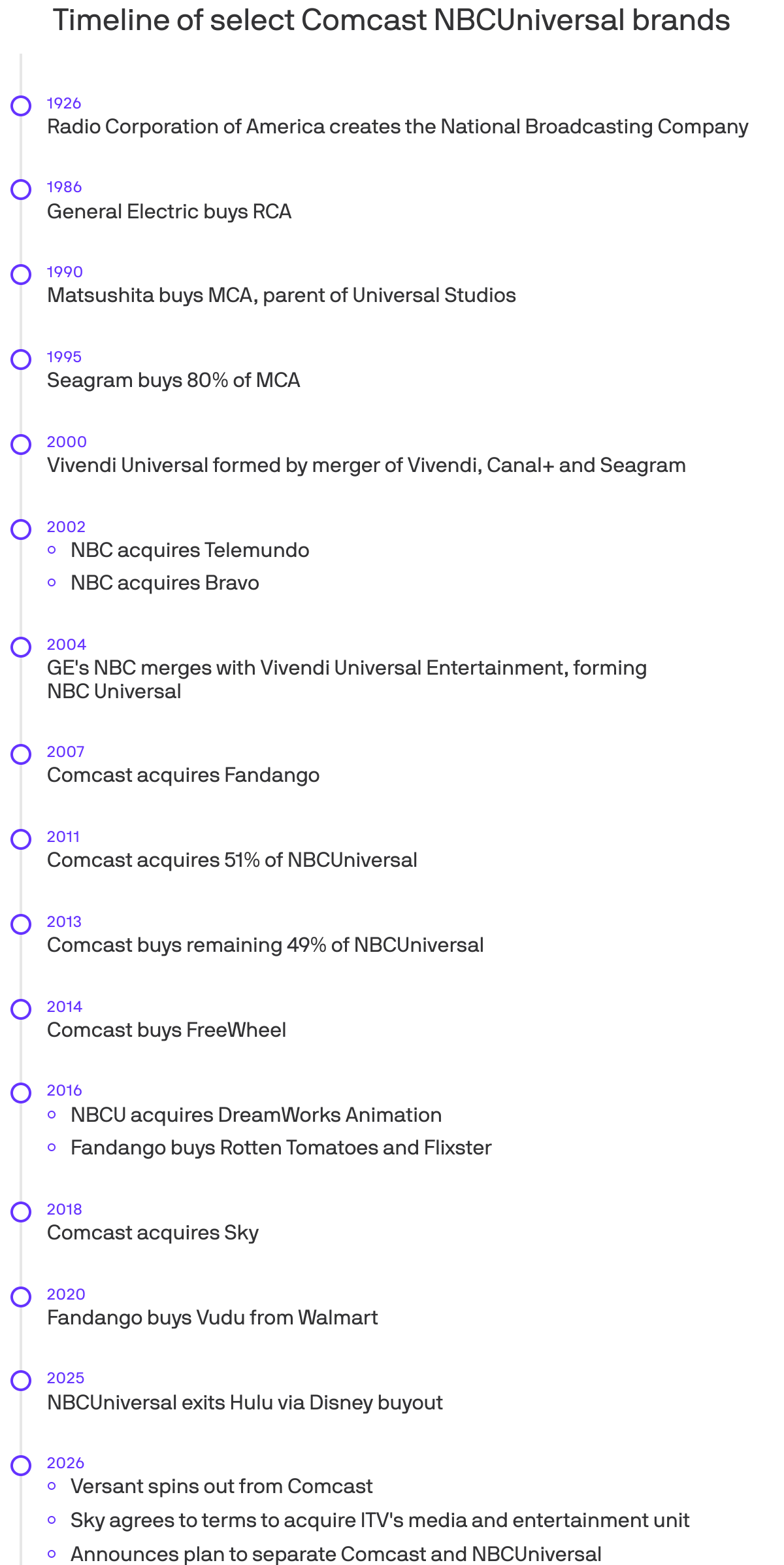
Timeline of select Comcast/NBCUniversal milestones (1926–2026) highlighting the 2026 events (Versant spin and the announced NBCUniversal/Sky spinoff); useful to contextualize the breakup as the latest step in a century‑long asset evolution. — Source: Axios
Is there a trade here for 2026–2027?
There might be several, depending on your risk tolerance and tools. If you run a simple long-only book, the default approach is to own CMCSA into the distribution, then reassess both tickers once you see capital policy and early guidance. If you traffic in pairs and spreads, there’s more to do.
One common setup: fade the initial euphoria, then buy the media spin after forced selling settles, especially if the parent announces a brisk buyback that props up the stub. Another angle is a relative trade against peer baskets — media vs. media, cable vs. cable — sized small until you get the debt and cap policy slides. Pure-play baskets often trade cleaner than the pre-spin conglomerate.
Times like this reward a checklist more than a hot take. Keep it dry, factual, and sequenced.
- Read the separation deck and Form 10 the day they drop. Flag debt, cash, pension, and intercompany agreements.
- Track first capital return comments from both boards. Buyback pace is a signal.
- Watch when-issued pricing for misalignments you can hedge.
- Revisit basis allocation and tax notes with your broker post-distribution.
- Map index inclusion and rebalancing dates to avoid stepping into mechanical flows.
If the teams execute, the parent could look like a steadier cash compounder and the spin a cyclical media bet with real IP and park leverage. If they don’t, it’s just financial engineering with a brief pop. The market already gave them the benefit of the doubt once with the premarket spike Financial Express. It won’t do it twice without proof.
Common Mistakes
- Chasing the headline pop. Premarket moves on spin news can fade fast. Size entries around when-issued and after the distribution when forced flow clears.
- Ignoring the debt split. Valuation talk is useless if one side gets saddled and the other is underlevered. Wait for the capital structure slides.
- Forgetting tax basis mechanics. A tax-free distribution still requires basis allocation between the two stocks. Confirm how your broker handles it.
- Assuming buybacks are automatic. Capital returns compete with network spend and content rights. Listen for explicit authorization and cadence.
- Missing index effects. Passive rebalances can push prices around for a few days. Check which index each entity is likely to land in.
If you want more plain-English takes on market structure moves and how they spill into digital assets and equities, we cover these crossovers regularly at Crypto Daily.
Frequently Asked Questions
Will the spin be tax-free for shareholders?
Comcast says it intends the distribution to be tax-free for U.S. federal income tax purposes Comcast press release (pdf). Always confirm your personal situation with a tax advisor, especially if you hold through non-U.S. entities or tax-advantaged accounts.
How will my cost basis be split between the two stocks?
After the spin, the IRS typically posts an allocation methodology based on relative market values at distribution. Brokers usually implement it for you, but it can take time. Keep records if you trade around the dates.
What happens to CMCSA options I hold over the spin?
Option contracts are usually adjusted so the deliverable reflects the new structure. Expect a bulletin from the Options Clearing Corporation outlining strike and deliverable changes. Liquidity can be quirky for a few sessions.
Could index changes force selling or buying?
Yes. One or both entities may shift index eligibility, which can cause mechanical flows from passive funds. Short windows of mispricing sometimes pop up around reconstitution or quarterly rebalances.
Does the retained 19.9% stake cap the spun stock?
It can. Comcast plans to retain up to 19.9% of NBCU for up to a year and monetize it over time Comcast press release (pdf). If markets expect block sales, NBCU’s near-term multiple may feel an overhang until the stake is absorbed.
What if the timeline slips past a year?
Delays happen. If closing moves out, models get stale and the market can reapply a conglomerate discount. The trade then becomes about patience and whether management keeps guiding cleanly through the gap.
Is there a dividend risk for either entity?
Possibly. Connectivity tends to support dividends and buybacks if leverage is sensible. NBCU will likely prioritize content and parks first. Wait for formal capital policies before penciling in yields.
Disclaimer: This article is provided for informational purposes only. It is not offered or intended to be used as legal, tax, investment, financial, or other advice.
Credit: Source link