


Bitcoin’s rebound has cleared the first test: price recovered. The harder one starts now: proving buyers remain after the squeeze.
Market Cap $1.26T
24h Volume $33.04B
All-Time High $126,198.07
BTC is trading near $63,195 on July 7, up 6.6% over the past seven days, according to CryptoSlate’s Bitcoin market data. That puts it back above the worst levels of last week’s selloff, yet the rally still needs proof of cash demand after traders caught short finish buying back positions.
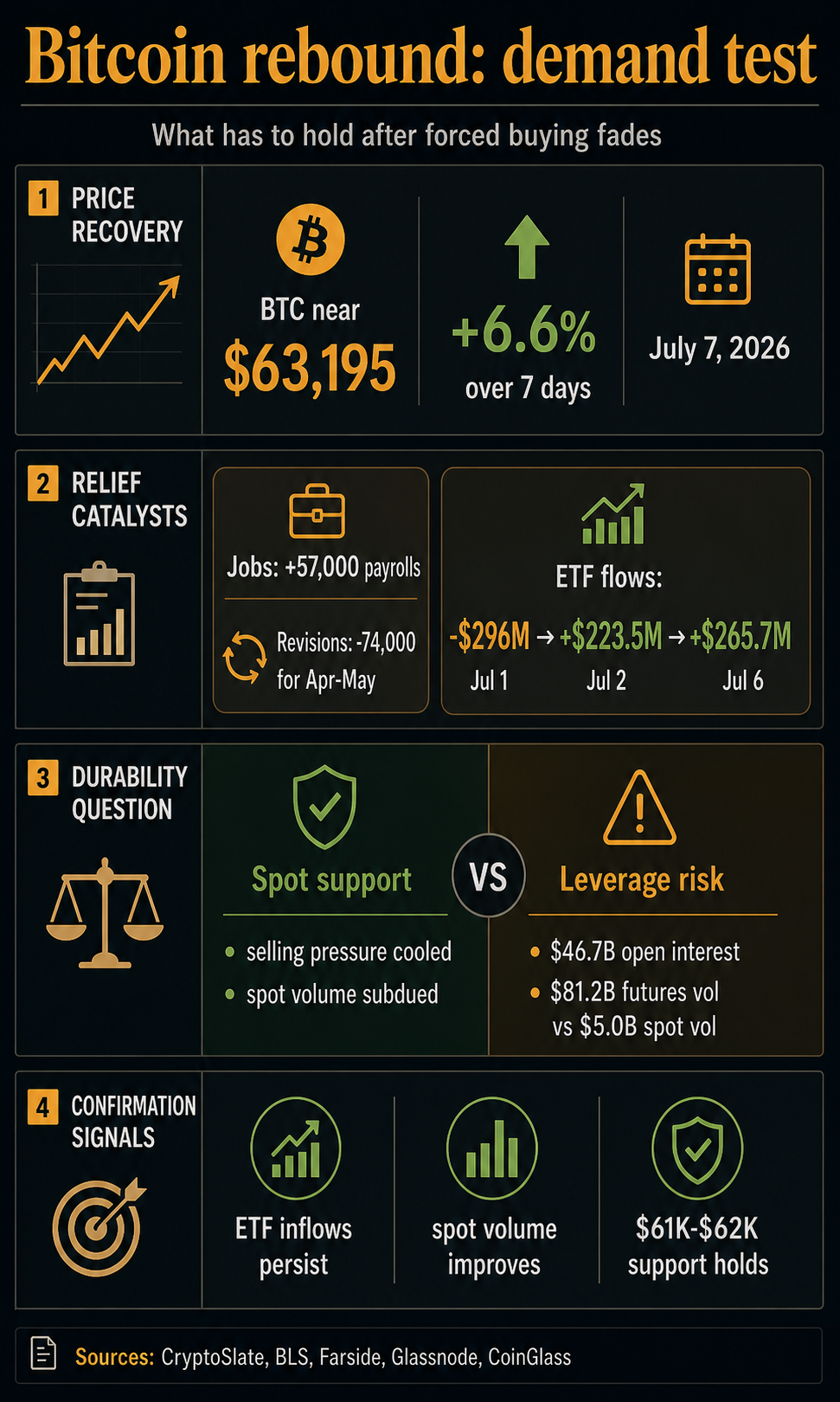
The macro backdrop helps. The Bureau of Labor Statistics reported that US payrolls rose by 57,000 in June, while April and May were revised down by a combined 74,000 jobs. For Bitcoin, weaker labor data can ease the rate-pressure story that had weighed on risk assets.
ETF flows also improved at the right moment. Farside Investors showed US spot Bitcoin ETFs moving from $296 million of total outflows on July 1 to $223 million of inflows on July 2 and $265 million on July 6. That repaired one visible demand channel, while a lasting recovery needs broader confirmation.

The reason is market structure. Glassnode’s Week 28 market pulse described Bitcoin as moving from aggressive distribution toward equilibrium, with spot selling pressure easing, ETF outflows cooling, and long-term holders helping anchor the market. The same report also said spot trading volumes remained subdued while futures open interest and long-side funding had risen. That leaves a cleaner market than last week, with the next leg dependent on participation beyond leverage.

That combination defines the immediate risk. Price can rise quickly when futures traders cover shorts or rebuild leverage, then lose support once the forced flow passes. CoinGlass showed roughly $46.7 billion in Bitcoin open interest on July 7, with 24-hour futures volume near $81.2 billion compared with about $5 billion of spot volume. Its liquidation data also shows why rallies can force shorts to buy back exposure quickly. Those figures support caution around a derivatives-heavy rebound.
The next test is simple. ETF inflows need to persist beyond one or two sessions. Spot volume has to improve without futures leverage doing most of the work. Buyers also need to defend the $61,000 to $62,000 area if Bitcoin retraces again.

If those signals hold, the July rebound starts to look like the beginning of a new base. If they fade, the move toward resistance will look like macro relief and short-covering arriving ahead of durable demand. For now, the burden sits with follow-through. The first leg showed sellers had lost momentum; the second has to show buyers are willing to stay.
Credit: Source link