



Bipartisan Senate talks over crypto ethics turned rocky this week after a Democratic source described an “about-face” by GOP members and the White House on a prior enforcement agreement.
The disputed provision would have allowed state attorneys general to sue the Justice Department for failing to enforce certain crypto ethics requirements.
As Punchbowl News and Eleanor Terrett reported, Senate Republicans floated a weaker ethics guardrail package during a bipartisan meeting on June 9, discussed removing the state enforcement provision entirely, and raised impeachment as a separate option.
GOP sources responded that senators not involved in the original ethics discussions later raised concerns about granting state officials the authority to bring actions against federal officials, including members of Congress.
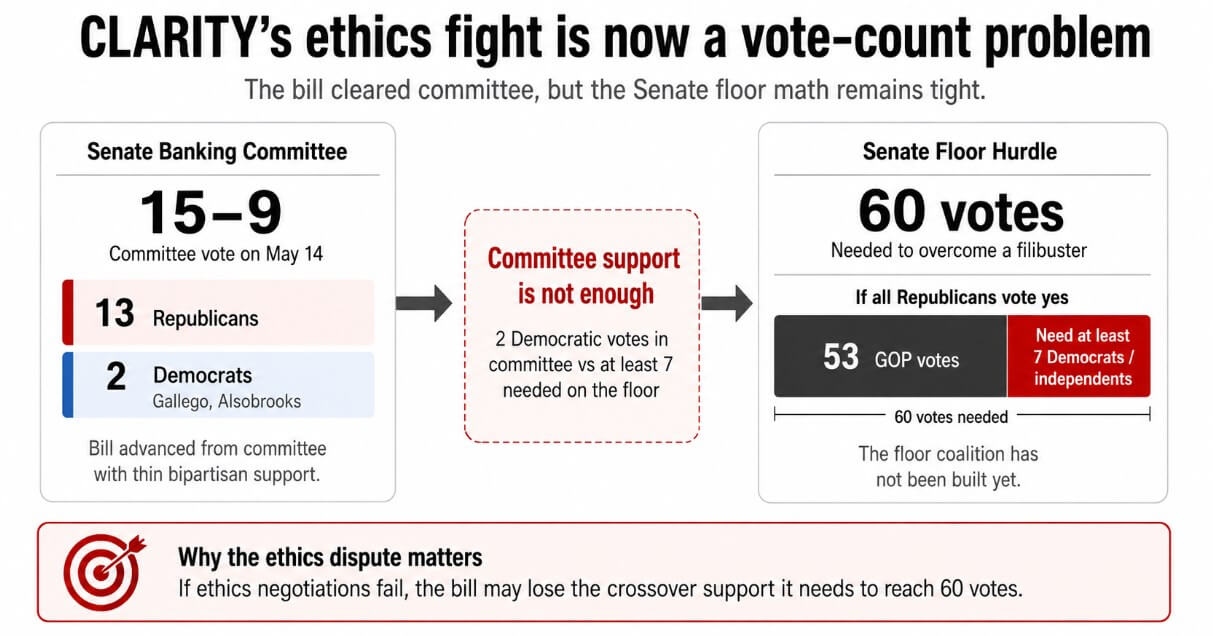
The floor math was already tight before the recent talks broke down. The CLARITY Act passed the Senate Banking Committee on May 14 by a 15-9 vote, with all 13 Republicans joined by Democrats Ruben Gallego and Angela Alsobrooks.
Yet the bill needs 60 votes to overcome a Senate filibuster, meaning at least seven Democrats must cross over if all Republicans vote yes.
Gallego warned he was “not afraid to vote no” on the floor if outstanding issues stay unresolved, and Alsobrooks described her committee’s vote as a commitment to keep negotiating in good faith.
How the ethics fight got here
The conflict-of-interest question has been on the table in CLARITY negotiations since September 2025, when 12 Senate Democrats released a market structure framework that demanded ethics provisions.
By January 2026, when the Senate Banking Committee released a 278-page draft, the ethics language was watered down.
In the May 309-page draft, it was gone entirely, marking a trajectory from demand to dilution to deletion, with Democratic senators publicly signaling that the bill was dead on arrival without a reversal.
At the May 14 markup, Sen. Chris Van Hollen’s amendment aimed to block senior government officials, including the president and vice president, from holding business ties to the crypto industry.
Republicans decided not to include the language, arguing that ethics considerations sit outside the committee’s remit and could be added via amendment on the Senate floor.
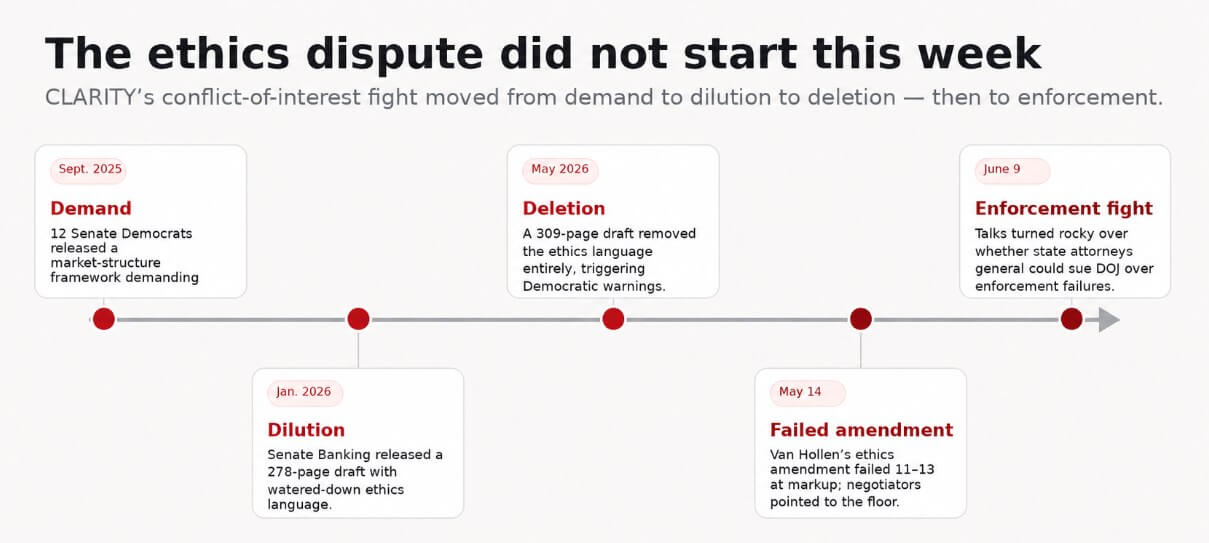
Crypto-friendly Democrats had argued that the committee needed to reach a deal ahead of the vote to avoid a future scenario in which the language is not included later, and the Van Hollen amendment failed 11-13.
Committee supporters had pointed to floor negotiations as the path to resolving ethics after that vote. Per Terrett’s reporting, Republicans and the White House are backing away from an agreement that had been within reach.
The specific mechanism in dispute, allowing state attorneys general to sue the DOJ over enforcement failures, would have put outside pressure on the Justice Department if Democrats believed federal officials were failing to enforce ethics rules.
Republicans counter that senators raised constitutional concerns about allowing state officials to bring actions against federal officials, including members of Congress.
What the enforcement dispute actually decides
Democrats need guardrails they can describe as binding, and the state-AG provision was the mechanism they had negotiated to make that case.
If the enforcement mechanism is removed or weakened beyond what swing-vote Democrats can defend publicly, the bill does not reach 60.
The bull case is that Republicans and the White House agree on an alternative enforcement mechanism, with impeachment and a separate judicial pathway discussed per Punchbowl, that produces a deal Democrats can bring to their caucus as enforceable.
Under that outcome, the bill reaches the floor with a coalition broad enough to clear the filibuster, and the ethics fight closes before it consumes the floor calendar.
Galaxy Research’s Alex Thorn currently estimates the probability of the CLARITY Act passing in 2026 at 60%.
The bear case is that Democrats conclude the ethics language is too weak, and Gallego and Alsobrooks do not carry their committee votes to the floor.
Analysts warn that slippage into 2027 is still possible if the floor calendar does not open in June, and senators have warned that failure before the August recess could push the next viable legislative window to 2030 or beyond.
A bill that clears committee with thin bipartisan support and then loses those two Democrats on the floor is a failed vote on the most consequential crypto legislation the Senate has considered.
Four more reasons the floor coalition is fragile
Ethics is the immediate fire, but four unresolved issues are still active, dragging on the coalition.
Senate Banking Democrats have targeted the bill’s anti-money laundering provisions, and a Sen. Elizabeth Warren-sponsored amendment to give Treasury authority to sanction DeFi services was rejected by all 13 Republicans at markup, leaving an enforcement split that Democrats can reopen on the floor.
On DeFi more broadly, the bill defines when trading protocols are “non-decentralized” based on control, discretion, or the ability to alter or censor operations, and requires rulemaking for how persons controlling such protocols comply with securities intermediary rules.
That definition leaves the bill politically exposed from both directions, as DeFi advocates push back on broad enforcement obligations, while Democrats use narrow definitions as a national-security attack line.
The stablecoin yield dispute reached a working compromise through the Tillis-Alsobrooks agreement, which prohibits stablecoin issuers from paying interest or yield on balances in a manner economically equivalent to an interest-bearing bank deposit, while allowing activity-based and transaction-based rewards modeled on credit card points programs.
Banks are still concerned about deposit flight, but that fight has moved to the margins. On procedure, the Senate Banking text still needs to be merged with the Senate Agriculture Committee’s parallel version before a full Senate vote, and any Senate-passed text would then need House approval, since the House passed its own version in July 2025 by 294-134.
That sequence, combined with the 60-vote hurdle, means the ethics fight has to be resolved before any of the other steps can move on a timeline that avoids the August recess.
| Risk | Current status | Why it matters |
|---|---|---|
| Ethics enforcement | State-AG mechanism under dispute | Could determine whether Gallego, Alsobrooks, and other Democrats support floor passage |
| Illicit finance / AML | Warren-backed DeFi sanctions amendment rejected by Republicans | Gives Democrats a national-security argument against the bill |
| DeFi treatment | “Non-decentralized” protocol test still politically exposed | Too strict angers DeFi advocates; too loose angers enforcement hawks |
| Stablecoin yield | Tillis-Alsobrooks compromise reached, but banks remain concerned | Lower-risk than ethics, but still a bank-vs-crypto pressure point |
| Procedure | Banking text must merge with Agriculture text, pass Senate, then likely return to House | The clock becomes a threat if August recess arrives before floor action |
White House adviser Patrick Witt has said the administration will accept ethics rules only if they apply across the board, from the president down, rejecting any provision that singles out the president specifically.
That posture frames the enforcement dispute as a substantive question about whether the bill’s ethics rules apply with equal force to the officials responsible for enforcing them.
Credit: Source link